
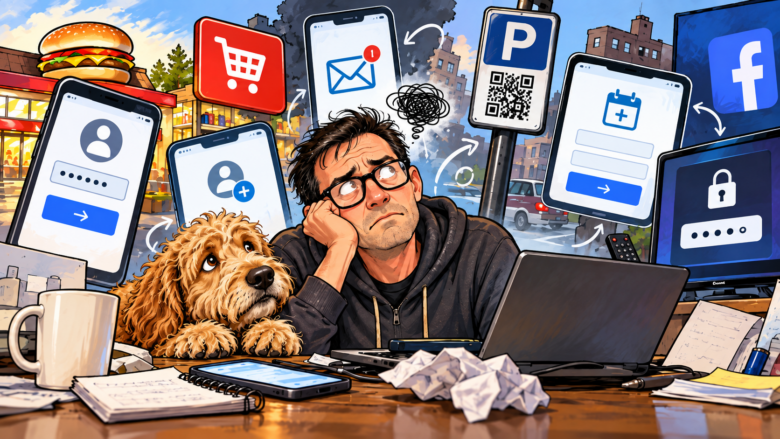
I once stopped going to one of my favorite fast food restaurants, not because the food was bad, or because I didn’t like the new fry cook. I couldn’t get their app to recognize me as a customer.
I tried for three weeks. Three separate occasions where I tried to make an order, thumb-wrestling my phone. The app had my name. It had my order history. It simply did not believe I was me, and it was not interested in any proof I had to offer. That was that. A restaurant I genuinely liked lost a customer not to a competitor, not to a bad experience, but to a password reset loop.
Somewhere in the last decade or so, we took things that used to require one human interaction — sometimes zero — and we streamlined them. We modernized them. We made them convenient. And the result is that nearly everything you do now requires you to first prove that you exist, agree to a terms of service you will never read, and create an account with a password that must contain at least one capital letter, one number, one symbol, and the tears of a minor deity.
Want a receipt? That’ll be your email address.
Want the sale price? The one advertised right there on the shelf, in the store you are physically standing in, next to the product you are holding in your hand? That price is for members. Go ahead and sign up for the rewards program. It’s free. It just requires your email, your birthday, your zip code, and your willingness to receive “exciting offers” for the rest of your natural life.
Want to make a doctor’s appointment? Create an account. Want to pay a bill? Create an account. Want to watch something on television — something you are already paying for — after a long day of creating accounts? Password, please. And not just any password. The one you set up eighteen months ago that you definitely remember.
You don’t remember it.
Nobody remembers it.
The “forgot password” button is the most-used button in America, I’m sure of it.
Now. If you want to see the full majesty of what we’ve done to ourselves, I want you to try parking a car in a city that charges for parking. Not a parking garage with a human being in a booth. A regular street spot, with a sign and a meter and a QR code on a little sticker. Here is your modern parking experience: scan the QR code, which will invite you to download an app, which you will download, which will ask you to create an account, which will ask for your email address, which will send you a verification link, which you will open, which will return you to the app, which will ask for your license plate number, which will ask for a credit card, which will process for a moment, which will confirm your spot, which will send you a confirmation email, which you will not read because you are already seven minutes late and also your meter is running.
That is not a streamlined experience. That is fourteen steps where there used to be one. The one was: put quarters in the machine.
We called this progress.
Here’s the part that butters my biscuits: Convenience is supposed to make life easier. An app for a business should offer deals and make interacting with the business legitimately easier with less friction. But now businesses have transferred a remarkable amount of work onto the customer and labeled it convenience. The business got the convenience. You got homework.
And if you look at what sits at the center of all of it — the receipts, the rewards programs, the apps, the accounts, the fourteen-step parking odyssey — it’s the same thing every time. They want your email address. That’s the prize. Everything else is the obstacle course they built around it.
I’m not even saying that’s evil. I’m saying they should be honest about it. Don’t tell me I’m downloading an app for my convenience. Tell me you want my email address so you can send me coupons. I respect that. I might even give it to you. But don’t hand me a Rube Goldberg machine and call it a shortcut.
Oh, and speaking of email addresses — I am aware, acutely aware, that The Georgia Sun is going to ask for yours at the bottom of this column. You can call it ironic, or call me a hypocrite if you want too, that’s fine.
Here’s the difference, and I mean this sincerely: you don’t have to create an account to read this. You don’t have to download a new app. There’s no QR code. There’s no license plate field. The reason we want your email is straightforward — so we can reach you directly, without having to hope that Facebook decides to show you your local news today, or that whatever third-party platform we’re on doesn’t change its algorithm on a Tuesday afternoon and suddenly, you’re getting cat videos and not news in your feed.
While we’re on the subject of Facebook, let’s talk about it. Let me be real for a few seconds. Part of the reason all of these businesses want us to create all of these accounts so that they can have our email addresses is because we spend all of our time on social media to the point where it is the place we find out about sales and deals, it is the place we get our local news and Facebook owns that data.
If you follow a business’ facebook page they have no way outside of facebook to reach you. You are Facebook’s audience and most businesses would like to have a relationship with their customers or clients without having to go through a socially inept tech bro who created a website to try and get girls.
Want the madness to stop? Stop getting all of your information from Facebook. Part of the reason everything in the world is so insane right now is because we have turned over every aspect of our lives to a tech bro who created an addiction he doesn’t want us to ever quit and it is destroying lives, families, and businesses.
And honestly, if I would have known back in 2009 when I created my Facebook account, that that one step was going to lead to having to create an account for every business I interact with? I probably would have decided to stay out of the pool. Turns out it was actually a cesspool that has bled out into the rest of the world.


B.T. Clark is the Publisher of The Georgia Sun and author of Principles Are Like Pants… You Ought to Have Some. Over two decades in journalism, he has served as Managing Editor of Neighbor Newspapers in metro Atlanta and Digital Director at Times-Journal Inc., earning multiple awards along the way. His work has appeared in newspapers across the state, including The Cherokee Tribune and The Marietta Daily Journal.
- B.T. Clark

- B.T. Clark

- B.T. Clark

- B.T. Clark