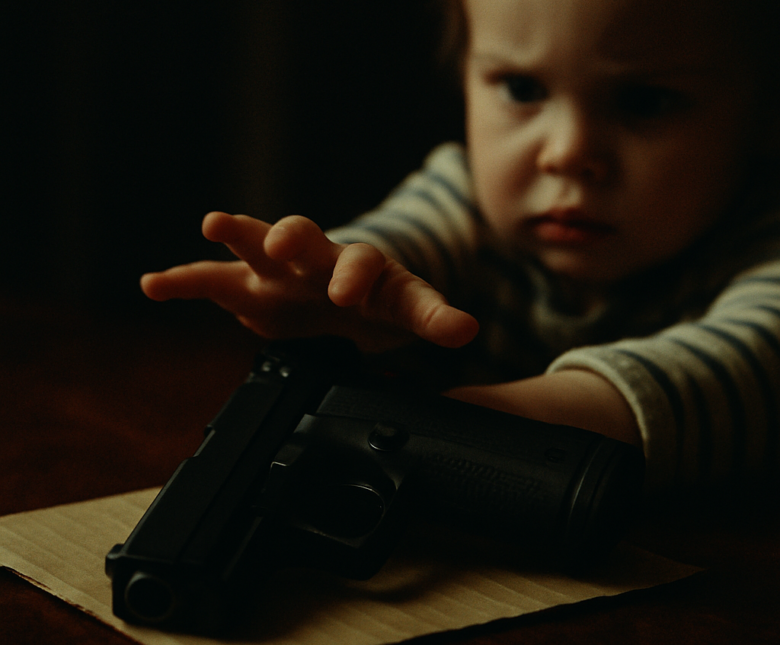
A Georgia mother is facing a recommended felony charge in Florida after investigators say her 2-year-old son was shot and killed when his 4-year-old cousin found a loaded handgun left within reach.
Now, the case is also putting a spotlight on a key difference between Florida and Georgia, what happens in the eyes of the law when a child gets access to an unsecured gun.
The Florida case that started the comparison
The Osceola County Sheriff’s Office said the shooting happened July 12 in Kissimmee, while the family was visiting from Louisville, Georgia.
Investigators said 2-year-old Brayden Tennyson was inside a vehicle with his 4-year-old cousin when the older child found a loaded handgun and fired it, hitting Brayden. The sheriff’s office said the children were unsupervised inside the car at the time.
Brayden was taken to a hospital and was pronounced dead, according to the sheriff’s office. Investigators said the family was in the area to celebrate what would have been Brayden’s third birthday.
The sheriff’s office said the gun belonged to Brayden’s mother, 37-year-old Shakelia Tennyson.
On Monday, the sheriff’s office said it had recommended a felony charge of culpable negligence. The case has been sent to the state attorney’s office, which will decide whether to file formal charges. The sheriff’s office said Tennyson has been notified and has returned to Georgia. No arrest has been announced.
What Florida law says about guns and kids
Florida has a child access prevention law on the books. The sheriff’s office pointed to that law in explaining the recommended charge.
Under Florida law, leaving a loaded firearm where a child can easily get it can be charged as a third-degree felony if someone is hurt or killed, according to the sheriff’s office summary of the statute. In Florida, a third-degree felony can carry a sentence of up to five years in prison.
In plain terms, Florida law gives prosecutors a clear path in cases where investigators believe an adult’s gun storage decisions put a child in position to fire a weapon.
That does not automatically mean charges are filed in every case. The state attorney still has to decide whether the facts fit the law and whether a case can be proven beyond a reasonable doubt.
What Georgia does, and does not, have
Georgia does not have a broad child access prevention law that works the way Florida’s does, meaning Georgia generally does not make it a standalone crime for an adult to leave a gun accessible to a child, even if the child later uses it.
Georgia also does not have a statewide safe storage requirement that applies across the board to gun owners in their homes, cars, or temporary lodging.
That does not mean there are no consequences in Georgia when a gun is left out and a child is hurt. Depending on the facts, prosecutors can still look at charges such as involuntary manslaughter, reckless conduct, cruelty to children, or other offenses. But those cases tend to be more fact-specific and harder to fit into a single, clear “gun left where a child could get it” law.
The result is a big gap between the two states.
In Florida, the storage decision can be the center of the case.
In Georgia, the storage decision is often just one part of a larger argument about recklessness or negligence.
Georgia efforts that have not made it to the finish line
For years, Georgia lawmakers have floated versions of safe storage bills and other proposals aimed at limiting child access to unsecured guns.
Those efforts have repeatedly stalled.
Supporters of safe storage laws have argued the state needs a clear standard that encourages responsible gun ownership and reduces accidental shootings and youth suicides.
Opponents have raised concerns about enforcement, government reach into private homes, and the risk that new laws could turn otherwise law-abiding gun owners into criminals. Some lawmakers have also argued education and voluntary safety programs are a better approach than criminal penalties.
The net effect is that Georgia has not adopted the kind of child access statute Florida already uses.
Kids keep finding guns
Even without a single Florida-style law, the problem Georgia lawmakers keep circling back to is simple: children do get access to guns, and people do get hurt.
The question for Georgia is not whether gun ownership is legal. It is. The question is whether the state can do more to prevent children from getting a loaded gun in the first place, without writing a law so broad it punishes responsible owners or infringes on Second Amendment rights.
That balance is where Georgia debates tend to break down.
Is it time for Georgia to revisit the issue?
This Florida case is a reminder of the policy choice Georgia has made so far.
Florida has a law designed to create criminal exposure when investigators say an adult left a gun where a child could easily reach it and someone is hurt or killed.
Georgia has left more of that terrain to broader criminal laws that are not written specifically around storage and child access.
Whether Georgia should follow Florida is often a political fight.
Whether Georgia should take another serious run at the problem is a public safety question that keeps coming back, because the moment a child finds a loaded gun, residents demand action either by calling on their representatives to pass laws similar to those in Florida, or by demanding greater responsibility from gun owners.

B.T. Clark is the Publisher of The Georgia Sun and author of Principles Are Like Pants… You Ought to Have Some. Over two decades in journalism, he has served as Managing Editor of Neighbor Newspapers in metro Atlanta and Digital Director at Times-Journal Inc., earning multiple awards along the way. His work has appeared in newspapers across the state, including The Cherokee Tribune and The Marietta Daily Journal.
- B.T. Clark

- B.T. Clark

- B.T. Clark

- B.T. Clark