

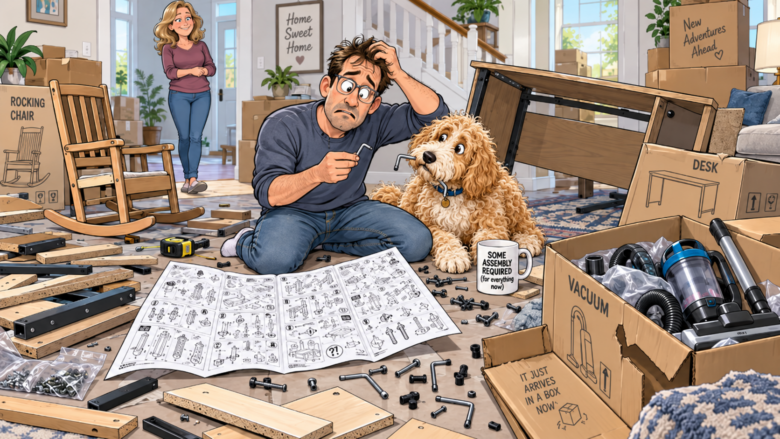
When we moved into the new house, we made a discovery that I suspect every person who has ever relocated makes within the first seventy-two hours, and that nobody warns you about in advance because they are either too traumatized to discuss it or they find your suffering entertaining.
Most of your old furniture doesn’t work in your new house.
It looks wrong, sits wrong, or is simply the wrong size for the rooms it now occupies. In one case, the lighting in the new house revealed stains on a couch that we didn’t see before. The furniture that looked perfectly reasonable in your old house walks into your new house and immediately becomes an embarrassment to everyone present.
So you do what any reasonable person does. You start replacing things.
And that is where the trouble starts.
I want to talk about flat boxes. Specifically, I want to talk about the national agreement we have all apparently made — without my consent, for the record — that furniture is something a company provides the raw materials for, and the actual construction of said furniture is your problem.
I don’t know when this happened. I don’t know who signed off on it. But somewhere along the way, the furniture industry looked at its customers and said, “You know what would be great? If we cut the boards, bagged up the hardware, wrote instructions in a font size that requires a magnifying glass and a degree in ancient languages, and then let the customer handle the rest.” And apparently we all just nodded and said fine.
It is not fine. Good quality furniture does not arrive in flat boxes and require an Allen wrench.
I can hear some of you already. There is a certain type of person — the type who can look at a raw piece of lumber and, through some combination of patience, skill, and a relationship with God that I clearly do not have — build their own furniture from scratch. That person is reading this right now and thinking, “Well, if you buy cheap furniture, that’s what you get.”
And I understand that argument. I do. But I would like to submit, respectfully, that I am not buying cheap furniture.
I am buying overpriced cheaply made furniture.
There is a difference. I am not going to the discount bin. I am paying roughly what the item in question is worth — and then I am opening a box that contains forty-seven pieces of pressboard, a bag of hardware, and a single Allen wrench that is approximately the size of a toothpick.
I do not believe there is a shelving unit on this earth worth more than two hundred and fifty dollars. I have looked at shelving units. I have used shelving units. A shelving unit holds things. It is not a cathedral. It should not cost what a used car payment costs, and it absolutely should not arrive in a condition that requires me to build it.
This started as an IKEA thing. IKEA was selling discount furniture with the agreement that you had to build it. Then every furniture company decided this was the model to go with — only they didn’t discount their furniture.
But I’m not going to just gloss over the Allen wrench, oh no. It deserves it’s own lambasting.
The Allen wrench is a tool designed by someone who wanted to make sure that no matter how many tools you own, you will never have the right one. It is a small, L-shaped piece of metal that comes in approximately nine hundred sizes, and the one you need is always the one that is not in the bag. The bag will contain six Allen wrenches. Five of them will be wrong. The sixth will be technically correct but will strip the bolt on the third turn, and then you will spend twenty minutes trying to figure out if the bolt is stripped or if you are just doing it wrong, and the answer is both, and neither, and it doesn’t matter because the shelf is already leaning.
I don’t have a problem with a little assembly. I want to be fair about that. If something arrives and I need to attach the legs or snap a couple of pieces together, I consider that a reasonable ask. That is assembly. What is not assembly — what is something else entirely, something that requires a different word — is when a box arrives containing a collection of flat boards that must somehow be fashioned into a desk.
That is not assembly. That is construction. That is a building project. I am not a carpenter. I did not go to school for this. I did not apprentice under anyone. I am a journalist, which means I am good at asking questions and bad at most things that require spatial reasoning, and yet here I am on a Tuesday afternoon, surrounded by pressboard and a diagram that appears to have been drawn by someone who has never actually seen the finished product, trying to build a desk.
The box says forty-five minutes. The box is a liar. For a man with my particular skill set, forty-five minutes is the time it takes me to locate all the pieces and confirm that something is already missing. The actual construction takes the better part of three days, during which Honey Doodle walks past the project at regular intervals with an expression that communicates, without words, that she had concerns about this from the beginning.
I used to work for a man who sold rocking chairs. Nice ones. The kind that sit on a porch and make you feel like you’ve earned something just by lowering yourself into one. They were not cheap. I will grant you that. But here is the thing about those rocking chairs — they were assembled in the shop. You bought the chair. You received a chair. A complete, finished, ready-to-rock chair that did not require you to do anything except sit in it and feel good about your life.
I think about those chairs now. I think about them with a tenderness I did not expect to feel about porch furniture.
Because I am not willing to spend a thousand dollars apiece for two rocking chairs that are going to sit on my porch, get rained on, and need to be replaced in five years. I’m just not. But I am also not thrilled about the alternative, which is buying two rocking chairs that arrive in flat boxes and require me to assemble them on the porch while the neighbors watch and form opinions.
And then — then — yesterday, a box arrived. It was about the size of a video game console. Maybe a little bigger. I looked at the label. It was the vacuum cleaner.
The vacuum cleaner.
It had to be assembled. Completely. From components. The vacuum cleaner, which is a device whose entire purpose is to make your life easier, arrived as a project.
I stood there in the foyer holding this box and I thought: this is where we are. This is the world we have built. A man cannot purchase a vacuum cleaner and simply vacuum. He must first construct the vacuum cleaner, and then vacuum, and then sit down because he is tired from constructing the vacuum cleaner.
I am just waiting, at this point. I am waiting for the day I buy a car and it shows up on my doorstep in a box the size of a microwave. Tires not included. Some installation required. Estimated assembly time: forty-five minutes.
In the meantime, I have a desk that leans slightly to the left, two rocking chairs that I assembled myself and am choosing to be proud of, and a vacuum cleaner that I built with my own two hands.
I am basically a craftsman at this point.
Don’t tell the Allen wrench I said that.


B.T. Clark is the Publisher of The Georgia Sun and author of Principles Are Like Pants… You Ought to Have Some. Over two decades in journalism, he has served as Managing Editor of Neighbor Newspapers in metro Atlanta and Digital Director at Times-Journal Inc., earning multiple awards along the way. His work has appeared in newspapers across the state, including The Cherokee Tribune and The Marietta Daily Journal.
- B.T. Clark

- B.T. Clark

- B.T. Clark

- B.T. Clark

- Keisha Lance Bottoms unveils her plan to lower grocery prices in Georgia
- Bibb County man opens fire on deputies
- Cumming teen dies after motorcycle crash on Peachtree Parkway
- One dead after Labor Day weekend triple shooting in Buford
- Labor Day Weekend Mystery: SWAT raids home after hearing gunfire. The home was empty