

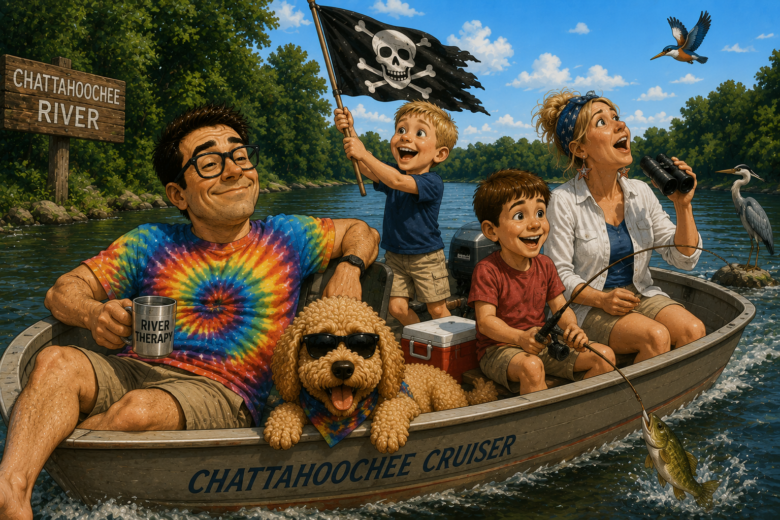
A group of volunteers in Roswell started something in 1976 with 6.7 acres and the conviction that people ought to have a place to fall in love with the natural world. No corporate backing. No capital campaign. Just people who looked at the Chattahoochee River and thought, this is worth protecting.
Fifty years later, the Chattahoochee Nature Center sits on 127 acres, draws more than 150,000 visitors a year, and just wrapped up a three-day anniversary celebration that brought about 1,500 people to its campus. They’ve got wildlife rehabilitation programs, environmental education, native plant conservation, and a nearly $10 million capital campaign that just finished funding a new River Welcome Center. They also have a new tagline: “Discovery Flows Here.”
I’ve taken my kids there more than once. My boys — the Wild Things, as regular readers know them — have stood on that riverbank and watched things move in the water and asked questions I couldn’t fully answer, which is, I think, exactly the point. There is something that happens to a child when you put them in front of something alive and wild and not on a screen. Something that brings wide-eyed wonder. I am grateful that 50 years ago, some volunteers decided that was worth fighting for.
So here is the question I’ve been wondering about all week.
When did that become controversial?
When did taking care of the earth — the actual ground we walk on, the water we drink, the air our children breathe — become a political position? When did “I’d like the river to be clean” become something you have to whisper at a dinner party depending on who’s sitting across from you?
A lot of you will say, “Oh, not this again. God created the Earth as a perfect planet, and it is arrogant to think we can destroy it.” A lot of you need to go back to Sunday School. But don’t fear. Back in the day, I was a Sunday School teacher, so let me take you to church.
In Genesis, God creates the world. He makes the light and the water and the land and the creatures and the plants, and after each one, the text says the same thing: it was good. Not “it’ll do.” Not “good enough for now.” Good. He looked at what He had made and called it good.
And then He made people, and He told them to tend it. To keep it. The Hebrew word used is “shamar,” which means to guard, to watch over, to preserve. He didn’t say “feel free to extract maximum value and pass the cleanup bill to your grandchildren.” He said take care of this. It is good. Steward it.
That is not a “libruhl” position. That is the first job description ever written.
So I want to know how we got from “God said the earth is good and commanded us to care for it” to “environmentalism is a socialist plot.” Because somebody sold us a pack of lies from the pit of hell that smell like smoke along the way, and I’d like to talk about who.
The man with five businesses and a private jet will tell you climate change isn’t real. He will say it with great confidence, possibly on television, possibly in a social media post with a lot of capital letters. He will cite studies you cannot find and experts you cannot name. And he will tell you this while his companies produce emissions he does not breathe, while his jet burns fuel he does not pay for in any meaningful way, while his grandchildren will inherit a world he will not live to see.
He is not a scientist or an expert. He is a man protecting a profit margin.
The man who owns the factory will tell you pollution is overplayed. That the regulations are strangling business. That your costs will go up if he has to take measures to keep the air and water clean. That the river was fine before the government got involved. He will not mention what the river looked like before the regulations. He will not mention the studies. He will mention jobs, because jobs are the magic word that ends the conversation, the one you’re not allowed to argue with, the one that makes you feel guilty for asking what’s in the water.
The man who owns the data center — the one that drinks a small lake’s worth of water every day to keep its servers cool — will tell you we have a water cycle and the earth is resilient and nature has a way of taking care of itself. He will say this from a building that consumes more water than most small towns, in a state that has been in a drought, and he will say it with the serene confidence of a man who has never once had to worry about his water bill.
What all three of these men have in common is that they are optimizing for their lifetime. If dismantling environmental protections adds another million to the quarterly numbers, they will dismantle them and leave the consequences in a box marked “future generations, not my problem.” They are not evil in a cartoon sense. They are something more ordinary and more dangerous: they are greedy, and they have convinced a significant portion of the population to be greedy on their behalf.
And a lot of you are eating it up.
The same man who tells you environmental regulation is government overreach is, in many cases, the same man who hasn’t given you a raise in four years. The same man whose lobbying keeps your healthcare expensive and your wages flat. The same man who will tell you with a straight face that he’s on your side while his accountant finds another way to move money somewhere you’ll never see it.
My friends, that is greed wearing a flag pin and claiming to be common sense.
The environment is not an abstraction. It is not a political platform. It is the air your children breathe on the way to school. It is the water you make their breakfast with. It is the river that 50 years ago, a group of volunteers in Roswell decided was worth protecting — not because it was profitable, not because a consultant told them to, but because they looked at it and thought, this is good, and good things deserve to be protected.
That is not a radical idea. That is the oldest idea there is, and according to Genesis, it is an idea bestowed upon mankind by God as his first commandment to us. So tell me, why you don’t want to recycle? Why you scoff at the idea of finding a fuel source that isn’t oil or coal? Why you call people who want to stop the woods from being bulldozed dirty hippies? You read a command about stewardship as a command to dominate with brute force and that wasn’t the intent. Genesis doesn’t keep saying it is good, it is good, it is good, just to give you permission to bulldoze everything that is good to prove your dominion. You need to go stand by the river for a couple of hours and re-think who you are and who you want to be.
The Chattahoochee Nature Center has been doing that work for half a century, one school group and one rehabilitated bird and one kid standing on a riverbank at a time. They started with 6.7 acres and a belief. They’ve got 127 now.
The river is still there. Still worth protecting. Still good.
Don’t let anybody talk you out of knowing that.

B.T. Clark is the Publisher of The Georgia Sun and author of Principles Are Like Pants… You Ought to Have Some. Over two decades in journalism, he has served as Managing Editor of Neighbor Newspapers in metro Atlanta and Digital Director at Times-Journal Inc., earning multiple awards along the way. His work has appeared in newspapers across the state, including The Cherokee Tribune and The Marietta Daily Journal.
- B.T. Clark

- B.T. Clark

- B.T. Clark

- B.T. Clark
- Man shot while visiting a woman in Augusta
- Burned tractor-trailer shuts down I-985 south of Exit 12
- Still Missing: Chatham County Police searching for missing Homeless man
- Owners of blighted property in Gwinnett face taxes seven times higher than other properties
- Two people found dead inside Glynn County apartment on Labor Day