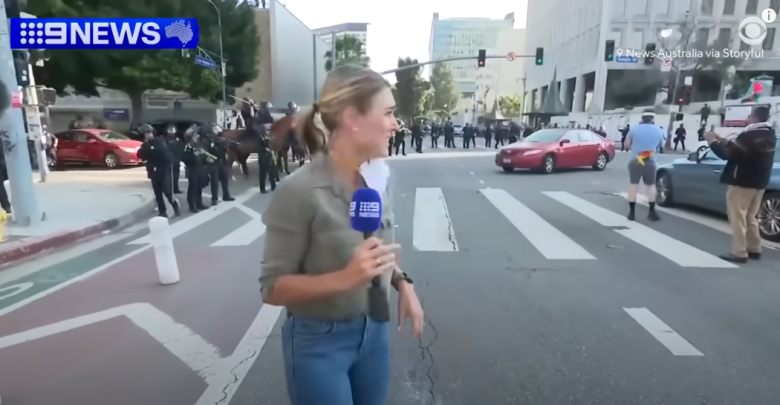
Journalists and press freedom advocates are raising the alarm after federal officers allegedly targeted reporters covering protests in Los Angeles.
🚨 Why It Matters: When law enforcement interferes with journalists documenting protests, it threatens the public’s right to information about important events and violates constitutional protections for press freedom.
📝 The Complaint: The National Press Photographers Association, Freedom of the Press Foundation, and other advocacy organizations have sent a formal letter to Homeland Security Secretary Kristi Noem expressing “alarm that federal officers may have violated the First Amendment rights of journalists” covering immigration-related protests in Los Angeles.
🔍 Between the Lines: The letter cites reports that federal officers “indiscriminately used force” against journalists and “deliberately targeted” reporters who were simply doing their jobs. In some cases, officers allegedly caused “serious injuries to journalists” who were not interfering with law enforcement activities.
In one video that has gone viral, an Australian journalist can be seen being specifically targeted and shot with a rubber bullet.
⚖️ Legal Context: The groups remind federal officials that constitutional standards protect press rights. Courts have consistently upheld journalists’ right “to photograph and record matters of public interest,” including law enforcement actions, as established in cases like Askins v. U.S. Dep’t of Homeland Security in 2018.
🛑 🛑 🛑
Before You Dismiss This Article…
We live in a time when information feels overwhelming, but here’s what hasn’t changed: facts exist whether they comfort us or not.
When A&W launched their third-pound burger to compete with McDonald’s Quarter Pounder in the 1980s, it failed spectacularly. Not because it tasted worse, but because customers thought 1/3 was smaller than 1/4. If basic math can trip us up, imagine how easily we can misread complex news.
The press isn’t against you when it reports something you don’t want to hear. Reporters are thermometers, not the fever itself. They’re telling you what verified sources are saying, not taking sides. Good reporting should challenge you — that’s literally the job.
Next time a story makes you angry, pause. Ask yourself: What evidence backs this up? Am I reacting with my brain or my gut? What would actually change my mind? And most importantly, am I assuming bias just because the story doesn’t match what I hoped to hear.
Smart readers choose verified information over their own comfort zone.

B.T. Clark is the Publisher of The Georgia Sun and author of Principles Are Like Pants… You Ought to Have Some. Over two decades in journalism, he has served as Managing Editor of Neighbor Newspapers in metro Atlanta and Digital Director at Times-Journal Inc., earning multiple awards along the way. His work has appeared in newspapers across the state, including The Cherokee Tribune and The Marietta Daily Journal.
- B.T. Clark

- B.T. Clark

- B.T. Clark

- B.T. Clark