

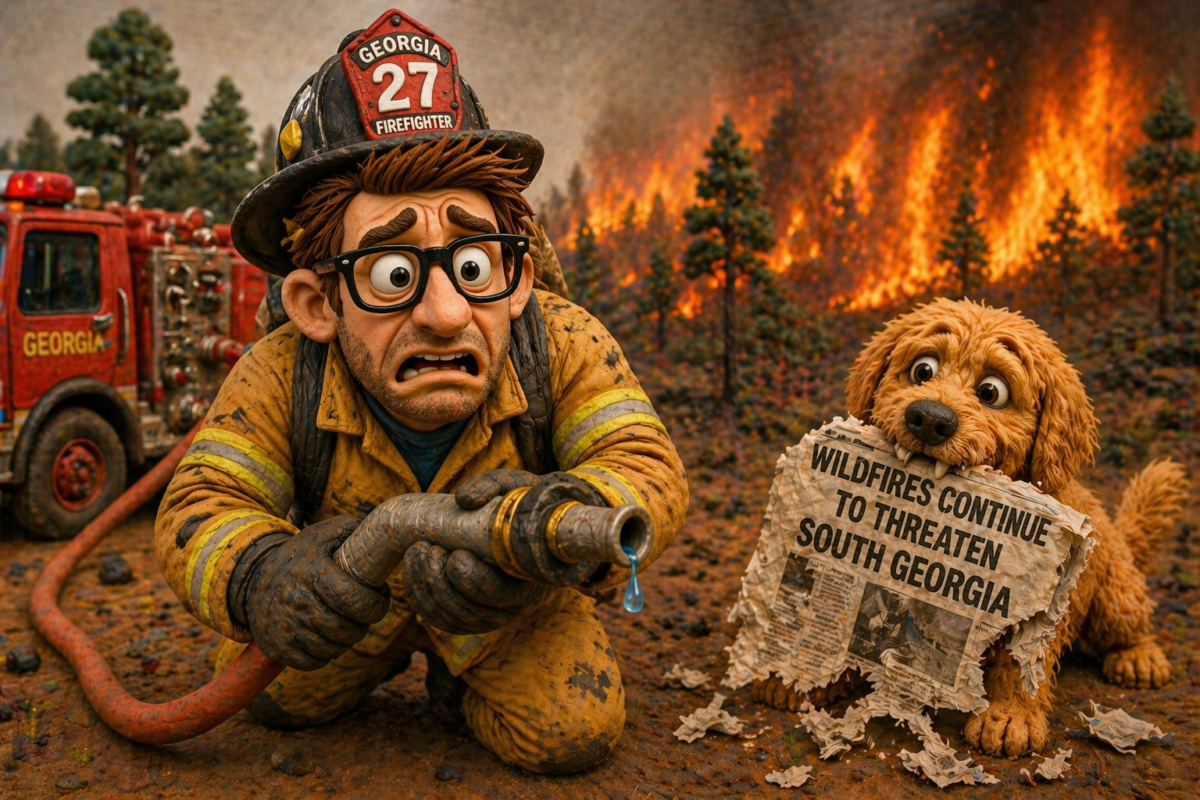
As I write this, I have been covering wildfires for three days.
Three. Days. Of wildfires. In Georgia.
There are currently two major ones burning — one in Brantley County, one in Echols County — that have already eaten through 11,000 acres. Over the weekend, there were 52 separate wildfires burning across this state. Fifty-two.
My guess is most of you didn’t know that.
My other guess is some of you stepped outside, caught a whiff of something smoky, shrugged, and went back to polishing your rifle. Which is fine. Brantley County is a long way from most of your living rooms. I get it.
What I don’t get — and what I’ve been sitting with for two days now — is that Georgia is also in a serious drought. That’s part of why we had 52 fires in a weekend. That’s why 11,000 acres can disappear so fast it makes your head swim. And most people I’ve talked to this week didn’t know that either.
The drought. The fires. The reason the sky looked strange Thursday morning.
All news. None of it apparently breaking through.
I’ve been in this business long enough to know why, and I’ll be honest — it’s not entirely your fault. The news has been exhausting for a while now. I cover it for a living and there are days I’d rather not. A lot of folks decided somewhere along the way that the best thing for their mental health was to check out entirely, and I understand the impulse even when I disagree with it.
But here’s what happens when you check out.
Last year I wrote no less than 18 articles about what was coming to health insurance in Georgia — the premiums, the coverage cuts, the impact on regular people. At least 18 articles, and that was just me. Other journalists at other organizations also sounded the alarm. Then the changes hit. And suddenly everybody wanted to know why nobody had warned them.
That is the cycle. I used to watch flabbergasted as the newspaper I worked for would cover a school board vote that allowed a cell phone company to plop a new tower right on the property of a local school. We’d write a story before the vote, we’d write about the vote, and then we’d sigh loudly when we got phone calls from people the day the bulldozers showed up to demand we do an “investigation” into how this happened. The day the bulldozers showed up. Months after it was already too late.
When you stop paying attention to local news, you stop knowing why your downtown suddenly charges for parking. You stop knowing which restaurants failed their last health inspection. You stop knowing what your county leaders are quietly voting on at seven o’clock on a Tuesday night in a room with 12 people in it — 11 of whom work for the county.
You miss the things that are actually happening to you.
And in missing them, you hand over something you can’t easily get back. Your power. Your voice. Your dignity. The ability to say, with any authority, “this isn’t right and here’s what I know about it.”
The state of Georgia is on fire right now. Literally, and in more ways than I have time to cover today.
I just thought somebody ought to say it out loud.

B.T. Clark is the Publisher of The Georgia Sun and author of Principles Are Like Pants… You Ought to Have Some. Over two decades in journalism, he has served as Managing Editor of Neighbor Newspapers in metro Atlanta and Digital Director at Times-Journal Inc., earning multiple awards along the way. His work has appeared in newspapers across the state, including The Cherokee Tribune and The Marietta Daily Journal.
- B.T. Clark

- B.T. Clark
- B.T. Clark
- B.T. Clark