
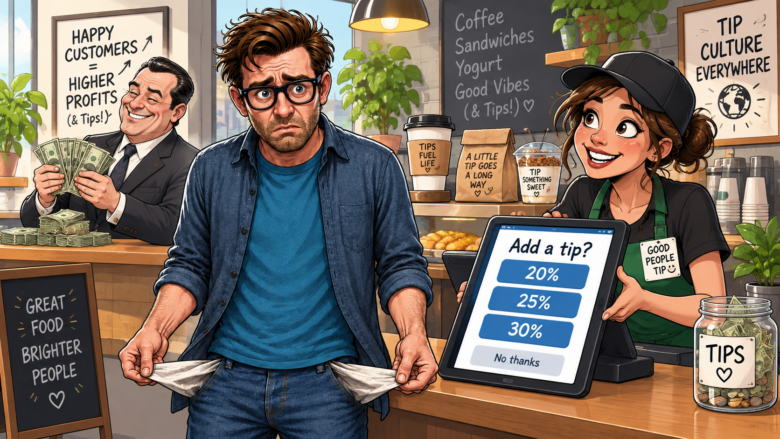
I have reached my tipping point. I have reached the point where if one more iPad swivels in my direction asking for a 25 percent tip on a cup of black coffee, I am going to tip the entire machine onto the floor.
It’s not just the coffee shops. It’s everywhere. The sandwich place. The yogurt shop. The food truck. The retail store. For what, exactly? For the heroic act of opening a glass door and handing me a beverage that was already cold? Did that require a level of service so extraordinary that it deserved a three-dollar bonus?
I remember a time, in not so distant past, when 15 percent was the standard tip for good service at a restaurant. If the service was truly spectacular, you might leave 18 percent, which was also the amount automatically added for large parties. It was a simple system. We all understood it. Then, somehow, 18 percent became the new 15, despite the fact that while prices change over time, percentages don’t need to. If the cost of the product or service went up, 15% of that also goes up all by itself. If you don’t understand that, please consult a math teacher immediately.
And now, we are told that 20 percent is the absolute floor. The bare minimum. Anything less and you are a monster who hates working people. For exceptional service, they say, you should be tipping 25 percent or more.
Now, before every server in the country starts composing an angry email, let me be clear: This is not about you. I see you. I appreciate you. I know you work incredibly hard for not nearly enough money. But you have been tricked. You have been duped into a system that allows your boss to pay you slave wages—in some states, as little as $2.13 an hour—and then point the finger at the customer when you can’t pay your bills. Your anger is justified, but it is aimed at the wrong person. The person you should be mad at is the one signing your pitifully small paycheck, not the person sitting at table seven who is already paying $22 for a hamburger.
The entire concept is absurd if you apply it to any other part of the economy. Can you imagine checking out at the grocery store and the cashier says, “That will be $284.50. The iPad is just going to ask you a quick question about my scanning performance.” Or your dentist, after finishing a root canal, wiping his brow and saying, “Alright, that was a tricky one. My Venmo is on the back of my business card if you appreciated me not hitting a nerve.” What about the greeter at Walmart? Should we be slipping him a fiver for his enthusiastic “Welcome to Walmart”?
The line used to be clear: You tip for table service. Someone takes your order, brings you your food, refills your drinks, and checks on you for the better part of an hour. That is a service worth rewarding. But now the tip jar is out at Subway. The iPad swivels at Moe’s. The barista who poured coffee from a carafe into a cup and slid it across the counter expects a tip.
You have to wait the table to get the tip. That was the deal. We cannot just change the rules because businesses figured out they can guilt customers into subsidizing their payroll.
Let’s be honest about where this custom comes from. Tipping culture in America became popular after the Civil War. It was a way for railroad companies and restaurants to hire newly freed slaves without actually having to pay them a living wage. It was, from its inception, a system designed to exploit labor. It is not some noble tradition; it is a racist relic that allows business owners to pass their costs directly to the consumer while pretending to be helpless bystanders. If the origin of our tip culture interests you, l’ll have more on that on Monday’s podcast.
And this brings us to the elephant in the room: the argument from restaurant owners and those who side with them that if we abolish tipping and pay service staff a living wage, prices will skyrocket. To which I say: Have you been out to eat lately? Prices have already skyrocketed. You are charging me 30 percent more for a meal that is 20 percent smaller, served by a skeleton crew in a restaurant that may or may not have been cleaned this week. You have already jacked up the prices for every reason and no reason at all. Don’t insult our intelligence by pretending that paying your employees a fair wage is the one thing your delicate business model can’t handle.
This is a uniquely American problem. Go to Japan or Italy or most of Europe. Try to leave a tip. You will be met with confusion, and in some cases, offense. They have a different system over there. It is a radical concept called “paying your employees.” The price on the menu is the price of the food, which includes the cost of the labor required to prepare and serve it. It is honest. It is transparent. It is how literally every other business works.
The problem is not the server. The problem is not the customer. The problem is greed. It is the restaurant owner who wants the profits of a high-end establishment while running it on a shoestring budget. It is a corporate culture that has decided that the customer’s wallet is the appropriate place to find money for employee salaries.
It is not my job to pay your employees. It is yours. Build it into your prices. Be honest about the cost of doing business. If you can’t afford to pay your workers a living wage, you simply don’t have a viable business.
As Franklin Roosevelt once said, “No business which depends for existence on paying less than living wages to its workers has any right to continue in this country.” For those who may have forgotten, Franklin Roosevelt was a pretty popular president. He swooped in, rescued the United States from the Great Depression and got elected to four terms in office. This was also almost 100 years ago and he was chiding greedy corporate owners way back then. The problem has only gotten worse.
If you’re having trouble paying your bills, but your boss has no problem buying a summer home or a new boat, that is the reason you’re having problems. Yes, the economy is currently somewhere between the toilet and the sewage plant, and yes, we have a war going on, but greed still accounts for an outsized portion of the economic pain of the working class. Somewhere along the line your boss, like everyone else’s boss decided that making a profit wasn’t enough, it has to be a 25% profit over last year’s profit. And where do they look when they can’t make those numbers? Your pocket. They cut your pay or your hours, cut staff, or underpay new hires.
If you are an employer, just stop it. It’s embarrassing the entire country. You are exploiting your workers, plain and simple, and then convincing them that the problem is the customers who are also being exploited by their employers.
Of course, once you convince an entire country that every routine task deserves a little something extra, word gets around. The dog brought me a sock this morning and stared at me expectantly. I gave her a treat. So apparently even she has figured out the system.



B.T. Clark is the Publisher of The Georgia Sun and author of Principles Are Like Pants… You Ought to Have Some. Over two decades in journalism, he has served as Managing Editor of Neighbor Newspapers in metro Atlanta and Digital Director at Times-Journal Inc., earning multiple awards along the way. His work has appeared in newspapers across the state, including The Cherokee Tribune and The Marietta Daily Journal.
- B.T. Clark
- B.T. Clark

- B.T. Clark
- B.T. Clark