
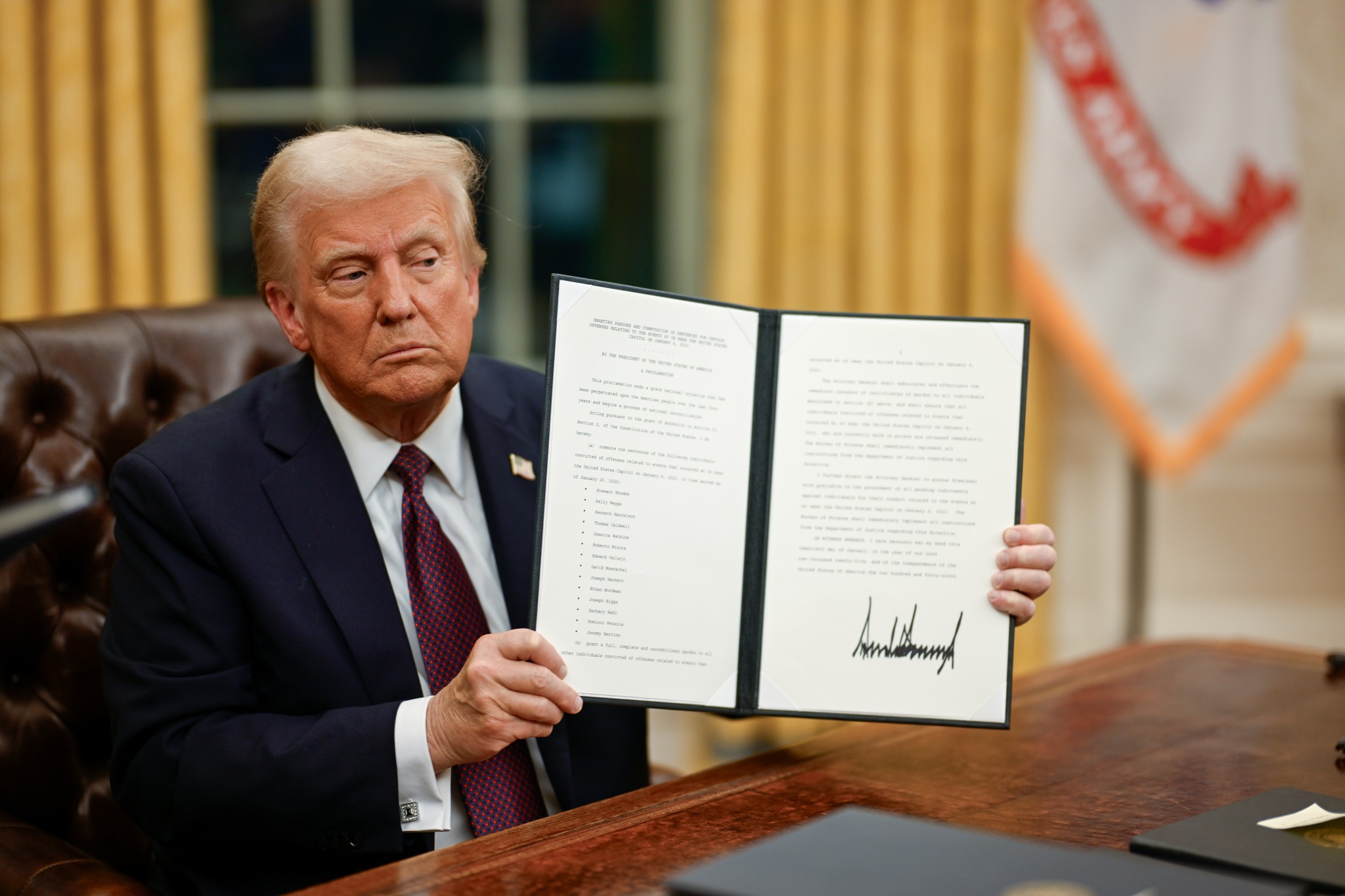
President Donald Trump signed an executive order Tuesday setting up a system where AI companies can voluntarily let the government review their most powerful AI tools before releasing them to the public.
What’s happening: The order creates a framework under which AI companies can give the federal government up to 30 days of access to their most advanced AI systems before those systems go public. The review is meant to let the government check for national security and cybersecurity risks. Taking part is voluntary.
What counts as a “covered frontier model”: Not every AI product would go through this process. Within 60 days, the government must build a classified benchmarking system — a set of tests run in secret — to decide which AI systems are powerful enough to qualify. The National Security Agency would make that determination. Companies can ask the government whether their product meets the threshold before they finish building it.
What this means for AI companies: The order does not require companies to hand over their products for government review, and it explicitly bars the government from using this framework to create a mandatory approval process. Companies that do participate can also work with the government to choose which outside partners get early access to their tools. Anthropic, OpenAI, and Google are named as likely participants. The order is a scaled-back version of earlier proposals that would have made the review mandatory and longer. Tech industry leaders had lobbied against stricter rules, arguing they would hurt U.S. competitiveness against China.
What this means for everyday people: The order does not change how individuals or most businesses can use AI. Its biggest direct effect on the public involves the security of systems people rely on every day. Within 30 days, the government must expand access to cybersecurity tools — potentially including advanced AI systems — to rural hospitals, community banks, and local utilities. The Attorney General must also make it a priority to prosecute anyone who uses AI to break into computer systems, steal data, or commit fraud. Federal laws covering identity fraud, computer fraud, and wire fraud are all cited.
The cybersecurity clearinghouse: The Treasury Department must create an AI cybersecurity clearinghouse within 30 days. It will scan for software vulnerabilities, confirm whether they are real, and help push out fixes. AI companies and critical infrastructure operators can join voluntarily.
Government deadlines:
- 30 days: Federal agencies must upgrade cybersecurity systems. CISA must issue binding directives to speed up cyber defense of civilian government networks and expand access to cybersecurity tools for state and local governments, hospitals, banks, and utilities.
- 30 days: Treasury must launch the cybersecurity clearinghouse.
- 30 days: OMB must determine whether federal grant money can fund AI vulnerability detection.
- 60 days: The government must finish the benchmarking system that defines which AI models qualify for review.
- 60 days: The Office of Personnel Management must expand hiring pathways for cybersecurity specialists.
The path forward: Because participation is voluntary, the order’s reach depends entirely on whether AI companies choose to engage. The government has no enforcement mechanism if companies decline to submit their models for review.

B.T. Clark is the Publisher of The Georgia Sun and author of Principles Are Like Pants… You Ought to Have Some. Over two decades in journalism, he has served as Managing Editor of Neighbor Newspapers in metro Atlanta and Digital Director at Times-Journal Inc., earning multiple awards along the way. His work has appeared in newspapers across the state, including The Cherokee Tribune and The Marietta Daily Journal.
- B.T. Clark

- B.T. Clark

- B.T. Clark

- B.T. Clark

- Have you seen these three missing Georgia teens
- Driver dies after runaway tire hits two cars on I-75
- 76-year-old ex-wife charged with murder after two people were found dead in a Georgia home
- Georgia Supreme Court sends child neglect case back to lower court
- Why is there a large police presence at Brantley County churches today?