
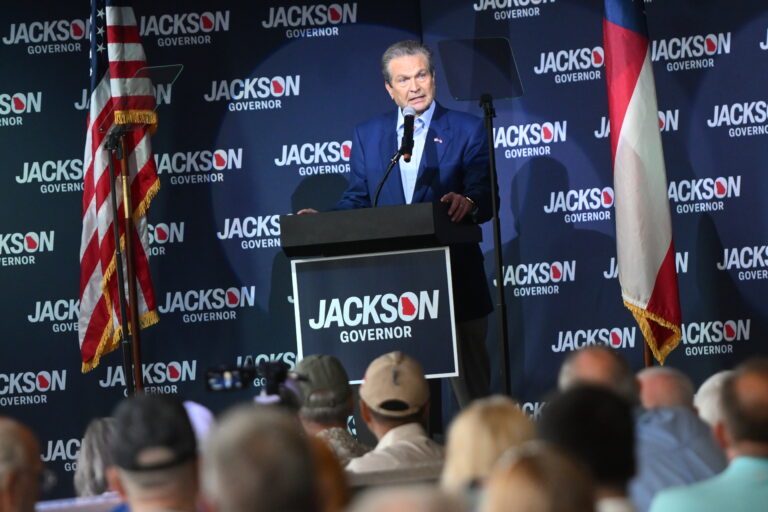
Lt. Gov. Burt Jones and wealthy healthcare executive Rick Jackson, both Republican candidates for governor, took differing campaign approaches Monday after Jackson missed a debate organized by the Atlanta Press Club, where Jones used an empty podium to continuously blast Jackson.
Jones and Jackson will compete in the June 16 primary runoff that will determine who will face Democratic nominee Keisha Lance Bottoms in November.
Jones, pointing several times to the empty podium, said that, unlike his opponent, he will be on the record about his stances.
“It just shows a man’s character when he won’t show up and take questions,” Jones said during the debate after questioning Jackson’s $1 billion in state contracts he received since 2020, as well as donations he made to Stacey Abrams and Liz Cheney.
He also pointed to a question he asked Jackson at the previous debate about whether Jackson hires immigrants who lack permanent legal status, saying that “he couldn’t answer that question then [and] probably the reason why he’s not here now.”
About an hour before the debate was set to begin, Jackson took the stage at Governors Gun Club, a shooting range and event venue in Kennesaw, for an event featuring Florida Republican U.S. Sen. Rick Scott. Jackson spokesman Brian Robinson said the campaign had already committed to holding the event with Scott and predicted it would have greater reach than the debate.
“You can see here, we have 600 people here at this event, and you can see the energy,” he said. “This is when Sen. Scott could come here, so we had to plan this for a long time. Obviously, he’s not a Georgian. We had to plan around his schedule.”
An enthusiastic crowd dined on sandwiches and salads as Scott introduced Jackson as a conservative outsider businessman in his own mold. When asked why they supported Jackson, many at the event called him a “self-made man,” citing his story of overcoming difficult family circumstances and starting a successful business. Several called Jones a “nepo baby” or said he was born with a silver spoon in his mouth.
Jackson echoed those characterizations in his remarks.
“Sen. Scott and I came from similar places,” Jackson said. “Neither one of us was born into the political class, neither one of us was handed a life of power or connections. We both know what it feels like to be counted out. My biological father was not there, I had seven different stepfathers, my mother battled alcoholism, I lived with five different foster families and I attended thirteen different schools. I know what it’s like to wonder whether anybody sees you.”
While Jackson repeated campaign talking points at the Kennesaw rally and did not take questions from reporters, Jones was pressed at the debate about having previously denied the 2020 election results when he served as one of the “alternate” Republican electors in Georgia who signed documents falsely proclaiming Trump won the 2020 election.
Jones, who was asked if he would have handled the 2020 election certification differently if he were governor at the time, said he advocated for a special session to roll back voting rules since Georgia “had two U.S. Senate seats that were on the line” headed to a January runoff. He claimed that the media misrepresented what he was doing andadded that he also wanted to investigate whether the allegations that the 2020 election was stolen were true.
He was also pressed on his connection to an 11-million-square-foot data center project that was proposed as part of a hospital and medical office facility to be built on land at least partly owned by his father, which was the largest data center proposed in the state at that time. Jones pushed back, saying he has no personal stake in the development and instead pointed to Jackson’s investment in a data center in Texas.
“I don’t have any personal business stake in the industry, but I’ve been accused of it, and my opponent, who’s not here tonight, and he does have ownership stake in data centers, but they’ve accused me, and they’re not true,” Jones said.
Jones pointed to efforts from the state Senate he backed that would have clawed back tax credits data centers receive, which was pitched as a way to pay for the income tax reduction, as well as eliminating income taxes on up to $50,000 a year for individuals and $100,000 for married couples. While the Legislature reduced the income tax to 4.99%, lawmakers ultimately did not pass the proposed corporate tax cuts meant to offset potential revenue losses.
Jones was also asked how he plans to offset a potential decline in revenue if he were to eliminate the state’s income tax entirely, which he has proposed. Gov. Brian Kemp recently cut about $300 million in new spending approved by the Legislature to help offset a $1.3 billion revenue shortfall caused by an income tax cut package. Jones pointed to another Senate effort he brought back from the 2026 session that would have cut millions in corporate tax credits.
Jackson’s proposal would freeze property taxes as well as cut the income tax rate in half, though he has not indicated how he would offset any revenue shortfall.
“We’ve got $30 billions of corporate welfare that we’ve been doling out for over two decades. That’s where we need to address some of those issues. The ones that you don’t have a good rate of return on, you need to get rid of those,” Jones said.
Georgia Recorder is part of States Newsroom, a network of news bureaus supported by grants and a coalition of donors as a 501c(3) public charity.