
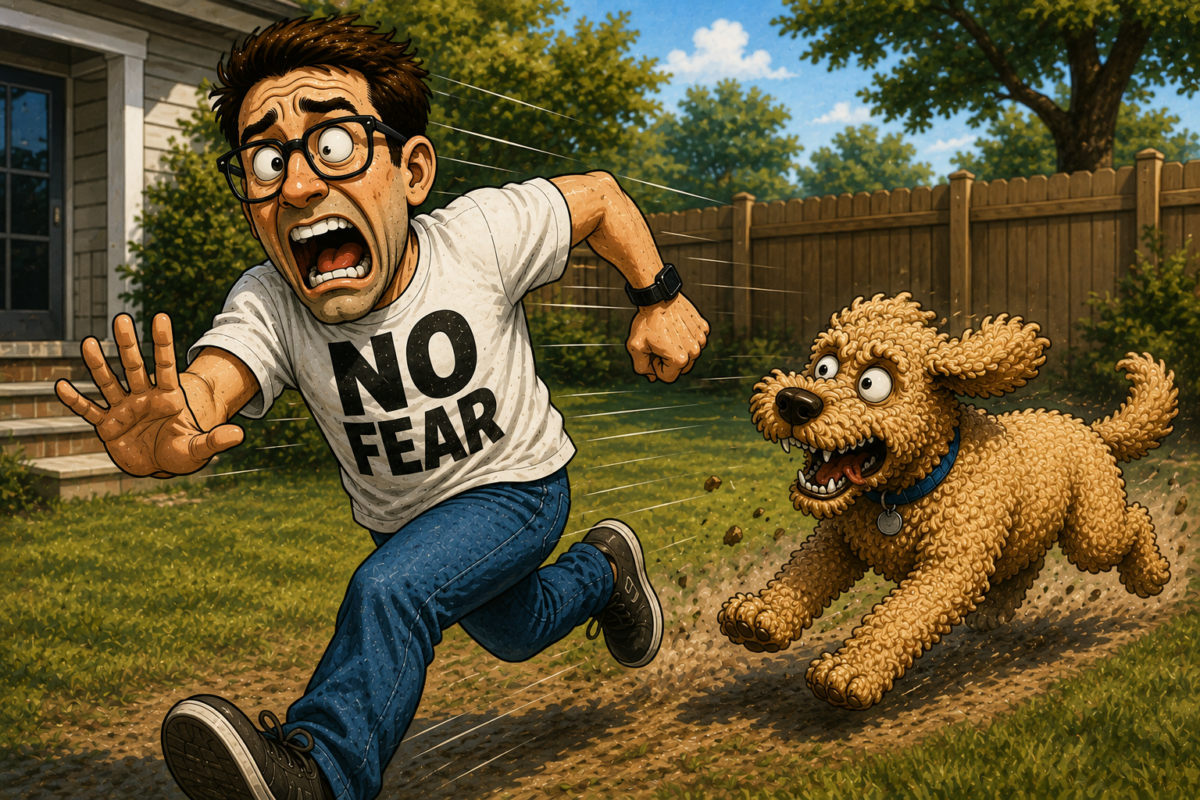
In 1989, a company called No Fear put its logo on a t-shirt, and an entire generation of Southern men decided that was a personality. You couldn’t go to a dirt track race, a bass fishing tournament, or a Waffle House at two in the morning without seeing that logo stretched across somebody’s chest. No Fear. Bold. Declarative. Printed in a font that communicated, without ambiguity, that the man wearing it had stared danger in the face and laughed.
These were the same men who wouldn’t go to the doctor.
The No Fear era overlapped perfectly with a generation of Southern males who treated annual physicals as a sign of weakness, who described chest pains as “probably just gas,” and who would sooner down two containers of Tums mid-heart attack than admit to another human being that something might be wrong. No Fear. Right there on the shirt. Right above the chest that hadn’t been listened to with a stethoscope since the Carter administration.
The South has always had a complicated relationship with fear. On Sunday mornings, the preacher tells you that God has not given you a spirit of fear. On Monday morning, the motivational calendar on your refrigerator tells you to feel the fear and do it anyway. The self-help books say fear is False Evidence Appearing Real. The country songs say real men don’t cry, don’t quit, and don’t back down. The bumper stickers say these colors don’t run.
And yet.
I want to take a little tour of the Southern landscape with you, because I have been paying attention, and what I have noticed is that we are, as a people, absolutely terrified. Not of anything specific, necessarily. Just terrified. Broadly. Comprehensively. In all directions simultaneously.
And the evidence is everywhere, if you know what you’re looking at.
Let’s start at the property line, because that’s where the fear begins.
Drive through any neighborhood in Georgia — any neighborhood, from the suburbs of Atlanta to the smallest town you’ve ever passed through on the way to somewhere else — and count the No Trespassing signs. Count the Beware of Dog signs.
These are not people who are unafraid. These are people who have constructed a perimeter.
I saw a post in a local Facebook group not long ago where a woman was threatening, in specific and colorful terms, what would happen to children who rode their bicycles through her driveway. Not her yard. Her driveway. For approximately fifteen seconds. Her security camera had picked up on two children riding their bikes in her driveway for 15 seconds and she wanted names and addresses. The kids, mind-you, looked to be all of eight-years-old. She claimed they were planning to vandalize her property later and were casing it.
Now, I want to note that if those had been her own children riding through someone else’s driveway, the response would have been “boys will be boys.” But these were other people’s children. On her property. For fifteen seconds. And she was ready.
That is not the behavior of a fearless person. That is the behavior of someone who is deeply, profoundly, existentially afraid of the world outside their front door — and has decided that the appropriate response is to defend the driveway like it’s the Alamo.
Some of you walk your dogs in your own neighborhoods while carrying a firearm. Your neighborhood. The one with the cul-de-sac and the HOA newsletter. You are armed for a walk around the block. I am not here to tell you that you can’t do that. I am here to ask you to be honest about why you feel you need to.
Speaking of which — the Supreme Court recently ruled that y’all can carry your firearm essentially anywhere you please in this country. Anywhere. The IHOP. The furniture store. The pediatric dentist’s waiting room, presumably, if the mood strikes you. The argument, as I understand it, is that danger can appear at any moment, in any location, and a prepared citizen must be ready.
Fine. Not gonna argue your rights or the Supreme Court decision. I am going to point out that this is not a fearless philosophy. That is the philosophy of a person who has decided that the world is so dangerous, so unpredictable, so thoroughly threatening, that no location is safe enough to be unarmed. That is, by definition, a terrified worldview. It is a worldview I understand, and I am not mocking it. I am simply pointing out that it is not the worldview of someone who has no fear. It is the worldview of someone who has a great deal of it and has chosen a particular response.
Then there’s the fear of the outsider.
Someone from somewhere that isn’t here is coming for your job. Coming for your vote. Coming for your healthcare. Coming across the border, coming from the city, coming from wherever it is that the people who aren’t like you come from. They are coming, and they are going to take something, and you need to be ready.
I understand the economic anxiety underneath this. I do. When people feel like the floor is unstable, they look for an explanation, and an explanation that involves a specific group of people is more satisfying than an explanation that involves complex systemic forces, because you can’t be angry at a systemic force. You can’t put a bumper sticker on it.
But let’s be honest about what this is. It is fear. It is the fear of scarcity. The fear of being replaced. The fear that the thing you have — the job, the neighborhood, the way of life — is not as secure as you need it to be. That is a human fear. It is a legitimate fear. It is not shameful.
What is a little bit shameful is pretending it isn’t fear while simultaneously building a wall around your driveway and carrying a pistol to the Cracker Barrel.
And then there’s the tax conversation. Every time someone suggests that Georgia might want to invest a little more in its schools, its health care, its roads — the ones that are, as I have noted before, crumbling — a significant portion of the population responds with a single word: communism. Sometimes pronounced “comernism,” which I appreciate for its authenticity.
There are legitimate debates to be had about tax policy. Reasonable people disagree about the size and role of government. That is fine. That is democracy. But when the conversation about fixing a pothole or keeping a rural hospital open gets immediately routed to “this is how it starts,” what you are expressing is not a policy position. It is a fear. A deep, abiding fear that the thing you have will be taken from you, that the system will be changed in ways you cannot control, that the world is moving in a direction you don’t recognize and can’t stop.
That is fear. Own it.
And while we’re owning things — let’s talk about our fear of the government. Roughly 20 percent of Georgians work directly for the government. When you add the people whose jobs depend on government contracts and government funding, you’re looking at somewhere between 35 and 40 percent of the state’s workforce that is, to use the technical economic term, “sucking off that gubment teat.”
I say this not as an insult but as a mathematical observation. A lot of the people most loudly afraid of government dependency are, themselves, dependent on the government. That is not hypocrisy so much as it is a very human failure to see ourselves clearly. Which is, incidentally, also a form of fear — the fear of looking in the mirror and finding something complicated.
But here is where I want to spend a little time, because this is the one that really gets me.
We had a pandemic. A real one. A documented, measurable, globally catastrophic pandemic that killed over 7.1 million people worldwide, more than a million of them Americans. It killed people we knew. It killed people whose names we read in the paper. It killed people who had names and families and a chair at a table that is now empty.
And a significant portion of the population decided that the most psychologically manageable response to this was to decide it wasn’t real.
Not that the response was imperfect — which it was, in ways worth discussing. But that it wasn’t real. That the deaths were from other causes. That the whole thing was manufactured. That the scientists were lying. That the vaccines were a conspiracy of such breathtaking scope and complexity that it required the coordinated silence of millions of medical professionals, researchers, nurses, and pharmacists across every country on earth, all of whom apparently decided to participate in a global hoax for reasons that remain unclear, but are often expressed by “THEY” were trying to bring about “comernism.”
I want to ask you something, and I want you to really think about it.
Why is it easier to believe in a conspiracy of that magnitude than to admit that you were scared?
Because that’s what this is. That is what all of it is. When the world suddenly revealed itself to be dangerous in a way that was invisible and indiscriminate and could not be stopped with a No Trespassing sign or a firearm — when the threat was something you couldn’t see coming and couldn’t shoot — the fear was so enormous, so overwhelming, so incompatible with the identity of a person who does not feel fear, that the only available exit was denial.
I was scared during the pandemic. I’ll tell you that plainly. I have a wife with a compromised immune system. I have children. I covered the story every day for months. I was terrified in a way that sat on my chest in the morning and followed me to bed at night. I did not enjoy it. I would not recommend it. I have less hair because of it. But I knew what it was, and I called it what it was, and I dealt with it accordingly.
The people who spent those years insisting it was all made up were not braver than me. They were more afraid than they could afford to admit. And that fear, unacknowledged and unprocessed, had to go somewhere. So it went into rage. Into conspiracy. Into a burning need to find someone to blame — a scientist, a politician, a neighbor who wore a mask — because blame is easier than fear, and anger is easier than grief.
I’ve said before in this column that we are losing our humanity. I believe that. And I think one of the ways we’re losing it is that we have decided, collectively, that fear is not a valid human emotion. That to feel it is weakness. That to admit it is surrender.
And so we don’t admit it. We buy the t-shirt. We put up the signs. We carry the gun to the furniture store. We call the pandemic a hoax. We threaten the bicycle children. We call the tax proposal communism. We demand more police on every corner while insisting we’re not afraid of anything.
And all that unacknowledged fear turns into something uglier. It turns into rage at the neighbor who got a vaccine. It turns into hatred for the person wearing a different color hat. It turns into a Facebook post about bicycling children that I genuinely cannot stop thinking about.
I am not here to tell you not to be afraid. Fear is human. Fear is appropriate sometimes. Fear is, in fact, one of the things that has kept human beings alive long enough to develop the capacity to put logos on t-shirts and argue about it on the internet. If fear was not a valid emotion, you wouldn’t see angels and messengers of God saying “Fear Not” so many times in the Bible. It isn’t a command not to fear, it is an acknowledgement that the presence of God is scary.
I am here to tell you to stop pretending.
If we truly live in the greatest nation that ever existed — and I have heard this claim made with great confidence at many a cookout — then perhaps we could afford to be honest about the fact that we are, nonetheless, afraid. Not because the country is bad. But because we are human. And humans are afraid sometimes.
One of the bravest things I have seen a person do is not carry a firearm into an IHOP. It is to sit across from another person and say, “I’m scared, and I don’t know what to do about it.”
That takes more courage than any t-shirt I have ever seen.
No Fear.
Sure, buddy.


B.T. Clark is the Publisher of The Georgia Sun and author of Principles Are Like Pants… You Ought to Have Some. Over two decades in journalism, he has served as Managing Editor of Neighbor Newspapers in metro Atlanta and Digital Director at Times-Journal Inc., earning multiple awards along the way. His work has appeared in newspapers across the state, including The Cherokee Tribune and The Marietta Daily Journal.
- B.T. Clark
- B.T. Clark
- B.T. Clark
- B.T. Clark
- Man shot while visiting a woman in Augusta
- Burned tractor-trailer shuts down I-985 south of Exit 12
- Gwinnett town hall will cover flock cameras, immigration policy, data centers
- Owners of blighted property in Gwinnett face taxes seven times higher than other properties
- Teen shot in Labor Day weekend road rage incident that started in South Carolina and ended in Augusta