

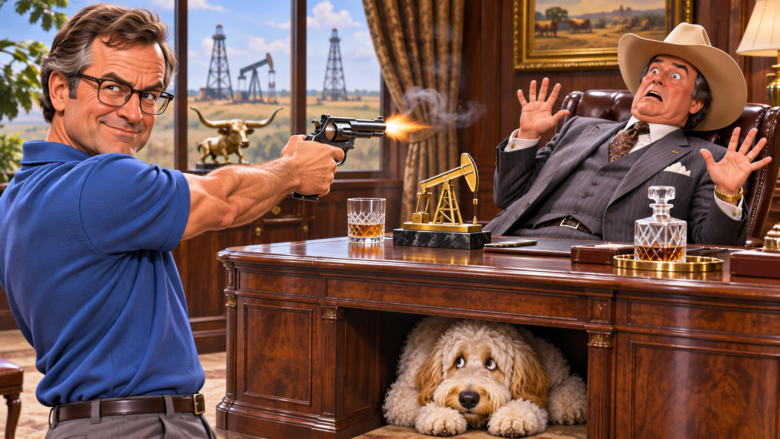
I have a confession to make. I loved the TV show Dallas. I grew up on it, and I still watch it regularly. Nobody forced me. I go back on purpose, the way some people return to a hometown diner where the coffee is mediocre but the memories are free.
When I was younger, people laughed at me for that admission because I enjoyed a soap opera. I used to explain the difference between a daytime soap and a night time soap. In a daytime soap, the main character, usually named ladybug or some other insect name cries out “Oh, Jake, please don’t leave me, I can’t live without you.” In a night time soap, the female lead points a gun and Jake and says “Jake, you bastard, you’re gonna eat lead for breaking my heart.”
Which brings us to a very important Dallas-related anniversary.
In case you’ve forgotten, the show was a craze, and “craze” may be underselling it. J.R. Ewing, the oil tycoon played by Larry Hagman, was the man America loved to hate, and he had a knack for making villainy look like a very well-tailored hobby.
Then, on March 21, 1980, in the season three finale, “A House Divided,” J.R. was shot by an unseen assailant. Roll credits. See you in eight months.
Eight whole months. There was no binging. You had to wait for the resolution. The events leading up to J.R.’s near demise were a work of art. Every character in the show, including J.R.’s mama, had reason to want him dead. The mystery became more of a phenomenon than the show itself. While we waited, the whole world talked. “Who shot J.R.?” was a dominant topic of conversation worldwide. International oddsmakers set odds on the culprits, and people bet freely. T-shirts asked “Who Shot J.R.?” and, for the more confident among us, declared “I Shot J.R.” The craze even showed up in the 1980 U.S. presidential election campaign, which is a sign that a cliffhanger has gotten out of hand, or has gotten very good, depending on your view.
I carry my own memory of it. For years afterward, kids at my elementary school played a game on their fingers. You held up your hand and chanted “Who shot J.R.?” and each time you put a finger down. When you were down to your thumb and forefinger, you said, “I did.”
Yes, a room full of eight-year-olds making finger guns and confessing to a shooting. Nowadays that would probably get them expelled, and the principal would call in a consultant with a laminated flowchart. Back then it was just recess.
The Night Everyone Knew
The mystery was solved on November 21, 1980, in an episode titled “Who Done It.” That date’s anniversary is this Saturday, about six days from now. An estimated 83 million U.S. viewers tuned in that night, one of the most-watched broadcasts in TV history. It had a 76 percent share of the audience, meaning three out of four households with a television on were watching Dallas. The culprit turned out to be Kristin Shepard, J.R.’s sister-in-law and mistress. At the end of the season, she ended up floating in the Ewing swimming pool while J.R. looked on amused from a balcony.
So, why am I telling you about the history of a nighttime soap opera? That night, and for eight months leading up to it, a large portion of the country had the same experience at the same time. The next morning, at work, at school, at the grocery store, everybody had something in common to argue about.
That was the nature of broadcast. Entertainment ran on a schedule, and the schedule made us an audience of neighbors. We shared the finales of television shows, the Super Bowl halftime show, the moon landing, and the water-cooler talk about whatever aired Thursday night. In the 90s we traded Seinfeld lines. Everybody knew what it meant to be “master of your domain,” what “not that there’s anything wrong with that” referred to, and how to use “No soup for you” as the ultimate rejection.
The Endless Buffet
Now we have streaming services, and everything is available all the time. It’s an endless buffet, and we each build our own plate. I’ll have the Scandinavian crime drama with a side of baking competition. You’ll take the true-crime docuseries and a mountain of reality dating.
Then the algorithms get involved, and it gets worse. What Netflix recommends to me, you may never see. What shows up on my Facebook feed is not what shows up on yours. The machine has studied us closely and decided to hand each of us a custom-made world, and the only thing that’s truly ready for binge-watching is our own isolation.
We are building a place where each of us has our own reality. It is a staggering part of what divides us. It’s hard to find common ground when we no longer even share the same ground floor.
Reclaiming the Moment
I’m not saying we go back. I like pausing a show to refill my ever-present Coca-Cola as much as anyone, and I’m not giving up my remote. Nobody is trading the buffet for a three-channel TV and rabbit ears.
I’m just saying we need to find a way to reclaim those shared experiences, some way to look up and find that all of us are looking at the same thing. Maybe it’s a game, a show, a local event, or something we haven’t invented yet.
Because the truth is, shared experience is not a luxury. It is the connective tissue of a community, the thing that lets a stranger at the gas station become a neighbor for thirty seconds because you both watched the same thing last night and can’t believe what happened. It is how we remember that the person across the aisle, the one we’ve decided to disagree with about everything, is still capable of being surprised, delighted, or outraged by the same story we are.
J.R. Ewing was shot forty-six years ago, and the whole world leaned in together to find out who did it. Nobody streamed it at their own pace. Nobody got a personalized recommendation. The schedule said Friday night, and Friday night it was, and for eight months an entire planet shared one unanswered question. That happened because the experience was bigger than the individual watching it.
We could use a question that big right now. Not about who shot a fictional oil baron, but about who we are to each other, and whether we still care enough to find out together. The answer won’t be in an algorithm. It’ll be in the moment we all look up at the same time and realize we’re in the same room again.

B.T. Clark is the Publisher of The Georgia Sun and author of Principles Are Like Pants… You Ought to Have Some. Over two decades in journalism, he has served as Managing Editor of Neighbor Newspapers in metro Atlanta and Digital Director at Times-Journal Inc., earning multiple awards along the way. His work has appeared in newspapers across the state, including The Cherokee Tribune and The Marietta Daily Journal.
- B.T. Clark
- B.T. Clark

- B.T. Clark
- B.T. Clark