
Amie Anderson’s first instinct was rage.
Her daughter, a nurse, had just told her how a young mother had walked into the hospital and surrendered her infant.
Under Georgia law, hospitals are among the safe places where a mother can leave her newborn.
“I was just like, ‘Who in the world does this and why?’,” the elder Anderson recalled recently.
“And I’m just raging. I mean all-Christianity-out-the-window raging,” she said. “And my daughter was like, ‘Mama no, no, no: she was so brave.'”
Amie Anderson then felt a sense of guilt so profound that it spurred her to spend three years prodding Georgia lawmakers to amend the law.
She searched online and found news about babies abandoned in dumpsters and trash cans.
She also saw heartening stories, such as one about a firefighter in Ocala, Florida, who adopted an infant left in the “baby box” at his fire station.
Then, she had an epiphany: some scared mothers needed anonymity.
“My assumption is that having to look a person in the face and hand that baby over is scary,” she said. “And when people panic, they do stupid things.”
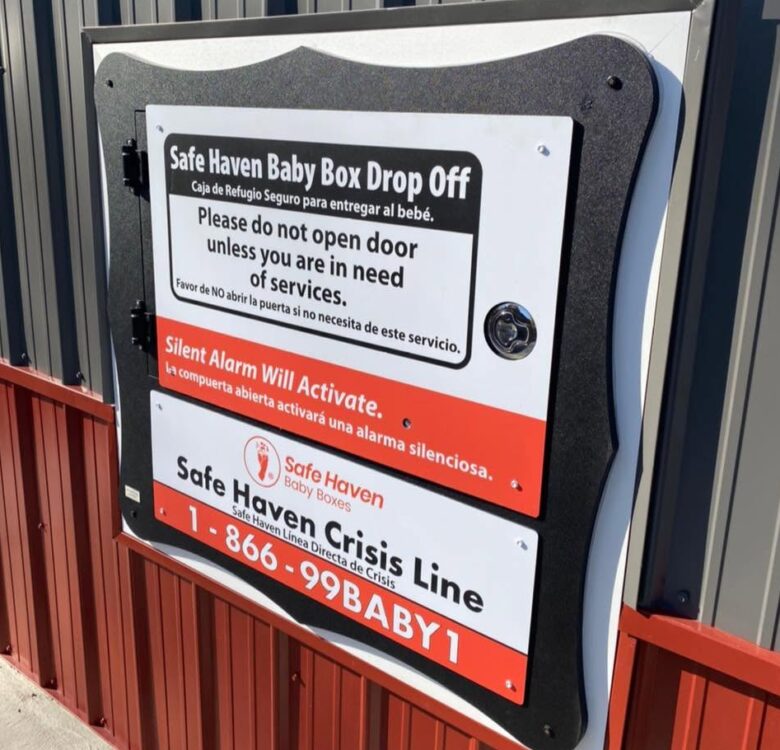
The Indiana nonprofit Safe Haven Baby Boxes made the box that delivered a baby girl to the Florida firefighter and his wife.
Each unit is built into an exterior wall at a fire station, hospital or other approved site. The temperature-controlled compartment contains a plastic bassinet. The external door locks after it is closed, and two alarms alert building personnel. The box also alerts 911 if no one opens the Plexiglass door on the inside and retrieves the baby.
Anderson called Safe Haven to ask about installing boxes in Georgia.
She said the organization told her she would have to get the law changed first. At the time, babies in Georgia could only be surrendered to warm hands at a designated safe place.
Anderson gathered allies, including her local state representative, who wrote legislation and then handed it to Rep. Mike Cameron, a Republican from Rosville.
Finally, this year, they got the box law passed, but it almost didn’t happen.
House Bill 350 got a final vote during the last minutes of this year’s legislative session.
The 164-4 House vote was nearly derailed by a Senate amendment. It required that a camera be aimed at each box, in case someone put something harmful inside.
A Democratic representative asked a salient question: Wouldn’t the loss of anonymity undermine the whole point of the boxes?
“No. Maybe not,” Cameron said, refusing to take more questions and calling for the vote.
He was worried about where that debate might go, and how long it might take, he recalled. “It was a nail-biter.”
Cameron, who lives in northwest Georgia, read accounts of these boxes being installed in nearby Tennessee. He said he thought Georgia should do the same.
Georgia is now among 27 states where they are legal, according to Safe Haven.
“There’ll be babies saved,” Cameron said.
During hearings in the Senate, some lawmakers expressed unease about the boxes and wondered about the need.
“It looks like a book depository or something,” one of them said.
Another, Sen. Brian Strickland, R-McDonough, said the concept gave him “kind of a weird feeling, because who would leave a baby in a box, right?”
But he said he felt obliged to vote for the bill because the GOP-led General Assembly had banned abortion once a fetal heartbeat is detected.
“If we’re going to be a state that is pro-life, this is also notice to parents, to moms, that we’re all in, and we’re willing to help you even if you think you have no options,” Strickland said. “So I support this.”
Anderson, who testified at that March hearing, said she feared the committee would table the bill. Even if it didn’t, she worried about the addition of a camera mandate. She said that would have violated Safe Haven’s rules about the anonymity of parents.
Then, Sen. Matt Brass, R-Newnan, mentioned an account of a young woman in his part of the state who had given birth to an infant, then placed her in a cooler and left her by the side of a road. The body of the infant was found days later.
Brass worried about a failure with the baby box safety features, for instance if the alarm that calls 911 rolled over to voicemail. Still, he said, “I do think this is a way better option than a trash can or a cooler.”
A week later, the senators heard from a woman who was forever scarred by the incident Brass referenced.
Anderson had called a friend who knew her and asked her to speak at the hearing.
Jill Patterson told the lawmakers about how a detective had come to her door in March 2020. The officer told her a dead infant had been found in Troup County more than a year before, swaddled in sweatpants and zipped into a rolling cooler decorated with a pattern of watermelon slices.
Genetic evidence had linked the baby to Patterson’s family.
“Within three minutes, I learned that I had a granddaughter and she was dead,” Patterson said.
She said her 19-year-old son did not know about his high school girlfriend’s pregnancy and that the news devastated him.
The infant’s mother later pleaded guilty in the child’s death and was sent to prison.
Patterson said her family struggled every Dec. 28, the anniversary of the 2018 death, and each March 17, the date they learned of the infant they would name Eliza Jane.
“There are no simple answers for my family. Just the cold, harsh reality of what happened,” Patterson said. “But there is a simple answer before you, ladies and gentlemen.”
That was all the bill needed, Cameron said. “We all broke up. It was just a horrific story.”
One of the reluctant senators was so moved that he asked to change the name of the underlying law.
The Safe Place for Newborns Act of 2002, which gave mothers immunity from prosecution when they left their infants in a designated safe place, would become the Eliza Jane Warner Act.
The committee added that amendment and others, including the camera mandate and a ban on using state funds for the baby boxes.
The next week, on the final scheduled day of the legislative session, the Senate voted 49-1 to pass HB 350. That was about half an hour before midnight. More than an hour later, the House approved the Senate’s changes.
In late August, a fire station in Henry County celebrated the installation of the first baby box in Georgia.
Anderson said her group wants to raise $100,000 to $125,000 to install several more in the county, at a cost of $20,000 to $25,000 apiece for the installation, training and ongoing maintenance.
And what about those cameras that undermine the case for anonymity, the reason a scared mother might be drawn to such a box in the first place?
“We were all very angry about the whole camera thing,” Anderson said, but she said Safe Haven was fine with the final language in the law.
The wording requires a camera capable of recording anyone who accesses a box. It was “not real specific,” Anderson said, so they put the camera inside the box.
“That camera goes directly to 911, and you can see the baby, and you can probably see mama’s arms,” she said, “but you cannot see mama’s face.”

Ty Tagami is a staff writer for Capitol Beat News Service. He is a journalist with over 20 years experience.
- Ty Tagami | Capitol Beathttps://thegeorgiasun.com/author/ty-tagami-capitol-beat/
- Ty Tagami | Capitol Beathttps://thegeorgiasun.com/author/ty-tagami-capitol-beat/

- Ty Tagami | Capitol Beathttps://thegeorgiasun.com/author/ty-tagami-capitol-beat/
- Ty Tagami | Capitol Beathttps://thegeorgiasun.com/author/ty-tagami-capitol-beat/

- Gas Prices in Georgia Are Heading Up Again
- Harris County High Baseball Coach Killed in ATV Crash
- BUSTED: Norcross man's $400K fake tax refund scam unravels
- Man found dead at Cobb County park after Valentine's Day disappearance
- Georgia's longest serving sitting college president is stepping down next year