
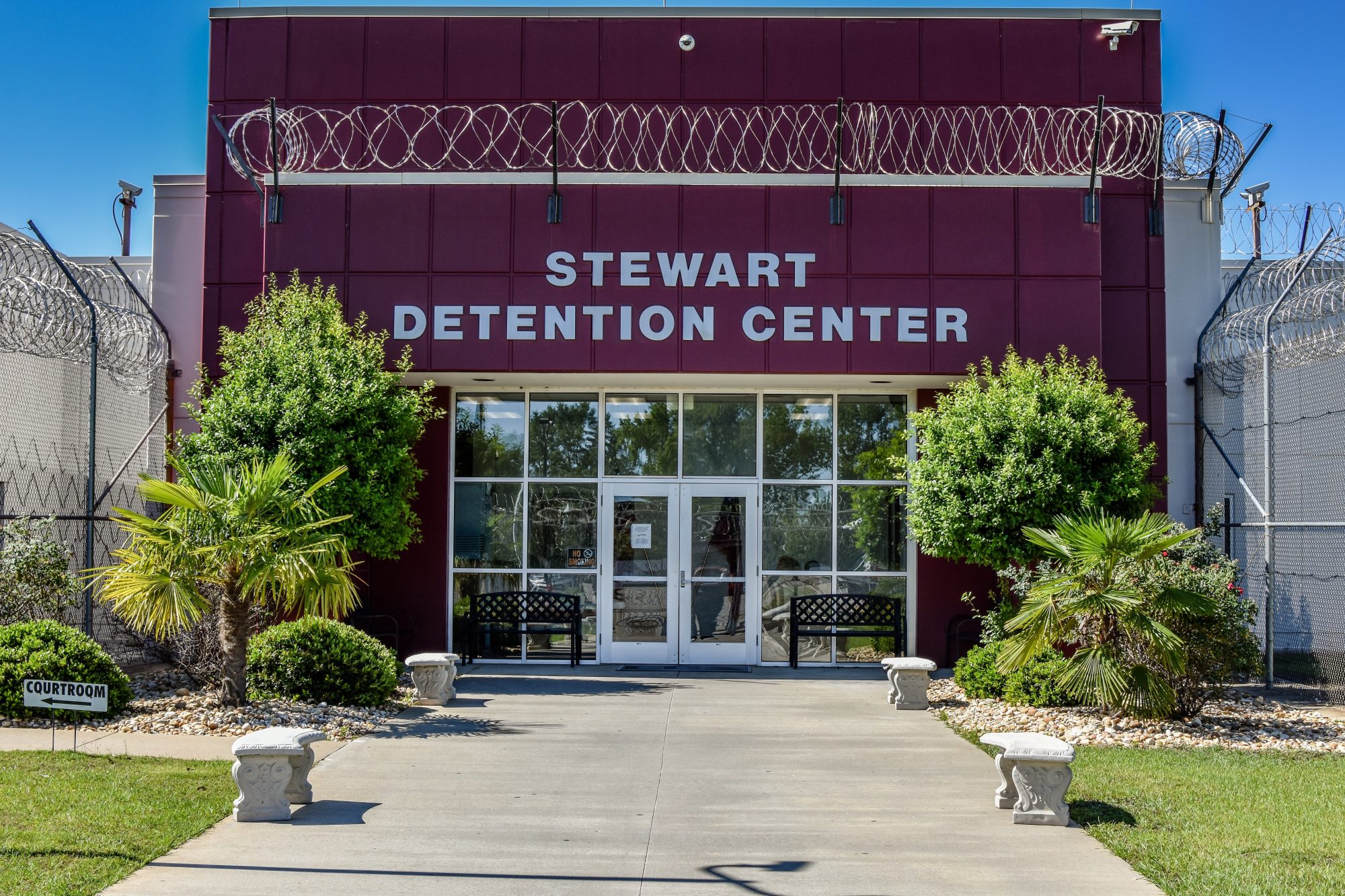
A Cuban man held at the Stewart Detention Center in Lumpkin died Tuesday in what federal immigration officials are calling an apparent suicide. It is the 18th known death in U.S. Immigration and Customs Enforcement custody so far in 2026 — and the fifth apparent suicide this year.
What’s Happening: Denny Adan Gonzalez died at Stewart, a privately run immigration detention center in Lumpkin operated by CoreCivic under contract with ICE. Immigration researcher Andrew Free, who reported the death before ICE’s official announcement, said Gonzalez had been held in solitary confinement — a practice where a person is kept isolated from other detainees, typically locked in a small cell for 22 to 24 hours a day.
The Record: The death rate inside ICE detention facilities this fiscal year is the highest recorded in at least two decades, according to research published in the Journal of the American Medical Association. That study tracked deaths from 2004 through January 19, 2026. Twelve more people have died in ICE custody since that date.
About Stewart: Stewart’s official capacity is 1,752 people. As of spring 2025, the number of people held there was reported to exceed 2,300. The facility has recorded 13 deaths since 2006, including three by suicide. In 2025, two men died at or near Stewart: 68-year-old Abelardo Avellaneda-Delgado died May 5, 2025, during transport to the facility, and 45-year-old Jesus Molina-Veya died by suicide June 7, 2025. ICE missed its own 48-hour deadline to publicly report both deaths.
What’s Still Unknown: ICE has not published all detainee death reports for 2026. For several of the 18 known deaths this year, no cause of death has been stated publicly.
Oversight Removed: In March 2025, the U.S. Department of Homeland Security shut down three internal oversight offices: the Office for Civil Rights and Civil Liberties, the Office of the Immigration Detention Ombudsman, and the Office of the Citizenship and Immigration Services Ombudsman. Those offices were responsible for reviewing conditions and complaints inside detention facilities.
What Doctors Are Saying: “As a physician, I am not surprised by this death — and that is precisely what makes it so devastating,” said Katherine Peeler, a medical advisor with Physicians for Human Rights and an assistant professor of pediatrics at Harvard Medical School. “Decades of medical evidence show that solitary confinement places individuals at significantly elevated risk of psychological deterioration and suicidal behavior. When someone in immigration detention is placed in isolation, already separated from family, community, social and legal support, the risk compounds. ICE has received this evidence repeatedly, through our reports, through congressional testimony, through research by their own oversight bodies. The continued and widespread use of solitary confinement in this system is not a failure of knowledge or understanding but a failure of will.”
Georgia Context: Georgia ranked fourth in the country for ICE raids in 2025, with more than 8,000 people taken into custody. In September 2025, U.S. Senators Jon Ossoff and Raphael Warnock sent a letter to federal officials demanding answers about deaths and conditions at Stewart. The senators cited sexual abuse, medical neglect, overuse of solitary confinement, overcrowding, barriers to legal help, forced labor, substandard food, and problems with the facility’s complaint system. A 2017 report found only one mental health provider for 1,800 detainees at Stewart.
The Path Forward: With 18 deaths already recorded in 2026 and the oversight offices that monitored detention conditions now gone, there is no independent body currently in place to review deaths or conditions at facilities like Stewart.

B.T. Clark is the Publisher of The Georgia Sun and author of Principles Are Like Pants… You Ought to Have Some. Over two decades in journalism, he has served as Managing Editor of Neighbor Newspapers in metro Atlanta and Digital Director at Times-Journal Inc., earning multiple awards along the way. His work has appeared in newspapers across the state, including The Cherokee Tribune and The Marietta Daily Journal.
- B.T. Clark

- B.T. Clark

- B.T. Clark

- B.T. Clark