


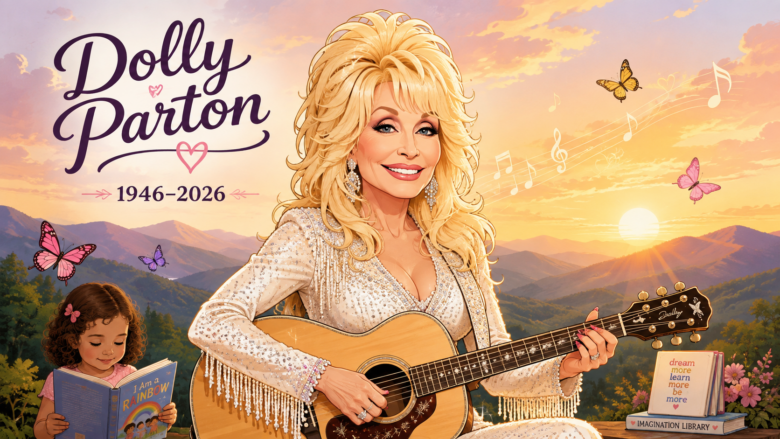
In 1987, Dolly Parton came into our living room every week.
She hosted a variety show on ABC called “Dolly,” and my family watched it faithfully. My mother loved Dolly Parton.
At the time, I didn’t understand why.
I was a kid, and Dolly was simply one of those people who seemed to have always existed. She had big hair, acrylic nails, a sparkling wardrobe and a voice that could cut through every other sound in the house. She was already a household name, a cultural landmark and, unfortunately, the subject of countless jokes about the size of her chest.
Dolly usually told those jokes better than anyone else.
That was part of her genius. She knew exactly what people saw when they looked at her, and she used it to her advantage. She built the caricature, covered it in rhinestones and stood behind it quietly taking notes while everyone underestimated her.
People saw the hair.
They often overlooked the mind underneath it.
I didn’t know much about Dolly’s music in those days. This was the 1980s, when Dolly Parton was everywhere, but I somehow managed to miss most of the point. She was less like a singer to me and more like a fixture. Dolly Parton was just part of the American vernacular, like Coca-Cola, McDonald’s and grown-ups complaining about interest rates.
Embarrassingly, I didn’t discover the wonders of “Jolene” or “9 to 5” until more than 20 years after they were written.
I have no excuse.
“Jolene” has everything a song needs: desperation, vulnerability, a memorable melody and a redheaded woman who apparently could dismantle a marriage merely by walking through the room.
“9 to 5” is so catchy you can almost miss the fact that Dolly is singing about economic exploitation, workplace inequality and the soul-crushing nature of corporate life.
That takes talent.
Got a minute? Got a story.
Back in college, during the Napster era, I started making a Christmas CD every year. Today, it is a playlist because technology has advanced and no one wants to watch me burn a compact disc at four-times speed while praying the computer doesn’t freeze.
The Christmas CD had strict rules.
Every song had to be about the actual meaning of Christmas. There would be no frivolous sleigh rides, no talking snowmen and absolutely no Bing Crosby under any circumstances.
No offense to Bing.
But when your grandmother owns only one Christmas record and every radio station spends December playing everything Bing Crosby ever recorded, his music begins to feel less like Christmas cheer and more like an annual performance review from 1947.
During the first year of my Christmas CD tradition, I stumbled across “Once Upon a Christmas” by Dolly Parton and Kenny Rogers.
It stopped me in my tracks.
The song is beautiful, haunting and reverent. Dolly and Kenny sing in a harmony that makes you suspect God briefly opened a recording studio in Nashville.
If you’ve never heard “Once Upon a Christmas,” listen to it.
If you’ve never heard Dolly and Kenny sing together, stop whatever you’re doing and correct that oversight immediately. Unless you’re performing surgery. In that case, finish up first, wash your hands and then put on “Islands in the Stream.”
Discovering “Once Upon a Christmas” made me take a second look at the woman I remembered from childhood.
I came for the Christmas music.
I stayed for Dolly.
The deeper I looked, the more I realized we had all been given a national treasure and some of us had been too distracted by the wigs to notice.
Dolly Parton wrote thousands of songs. She wrote “Jolene” and “I Will Always Love You” on the same day, which is the songwriting equivalent of Leonardo da Vinci painting the Mona Lisa before lunch and then knocking out The Last Supper because his afternoon meeting got canceled.
When Elvis Presley wanted to record “I Will Always Love You,” his manager demanded half the publishing rights. Dolly desperately wanted Elvis to sing her song, but she said no.
She kept ownership. Priscilla Presley once said that Elvis loved the song so much that he sang it to her on the courthouse steps the day their divorce was finalized.
Years later, Whitney Houston recorded it, and Dolly’s decision became one of the greatest lessons in music-business history: You can be kind without being foolish, generous without surrendering and polite while firmly telling Colonel Tom Parker to take a long walk off a short rhinestone-studded pier.
That was Dolly.
She knew who she was. She knew what her work was worth. She didn’t need to belittle anyone to prove it.
If you’ve read many of my columns or my book, you know that integrity and character are sticking points for me, and if you’re looking for a person who exemplifies both, Dolly Parton is your answer.
She understood that success means very little if you don’t use it to help someone else.
Her Imagination Library has mailed hundreds of millions of free books to children. She started the program in honor of her father, who could not read or write, and turned that personal family pain into a worldwide literacy effort.
She gave scholarships to students.
She supported hospitals and children’s causes.
When wildfires devastated East Tennessee, her My People Fund provided direct financial help to families who had lost their homes.
She donated $1 million to COVID-19 research at Vanderbilt University, helping fund work connected to the Moderna vaccine.
She poured money and jobs into the mountains where she grew up. Dollywood was not simply a vanity project with roller coasters and funnel cakes. It became one of the largest employers in the region and helped provide livelihoods for generations of East Tennessee families.
She stood up for people who were different from her.
She spoke openly about loving and accepting her LGBTQ fans.
She supported racial justice without wrapping the message in eight layers of public-relations language.
She lived out a version of faith that was warm, welcoming and far more interested in loving people than inspecting them for doctrinal defects.
And she did all of it while refusing to pretend she was something she wasn’t.
She once famously said, “It costs a lot of money to look this cheap.”
That line is funny, but it is also a declaration of independence.
Dolly created herself. She took the poverty of her childhood, the pain she witnessed, the faith she inherited, the music she heard in the mountains and the image people mocked, and fashioned it all into something unmistakably her own.
Then she used what she built to make life better for other people.
Talent is wonderful, but talent without character eventually curdles. Fame can make a person larger, but it rarely makes them better.
Dolly Parton somehow became both.
She was a gifted songwriter, a brilliant performer and a shrewd businesswoman. But more important, she was kind without being naïve, generous without making a production of it and strong without becoming hard.
My mother saw something in Dolly Parton long before I did.
Maybe she heard it in the songs. Maybe she recognized the steel beneath all that sparkle. Maybe she simply understood that the woman laughing at herself on television was smarter than everyone in the room.
It took me years to catch up.
Dolly Parton was always there — on television, on the radio, in the jokes people told, in the songs other artists sang and in the books arriving in children’s mailboxes.
She was so woven into the fabric of American life that it was easy to assume she would always be there.
But people age. The curtain eventually falls. Even the brightest stars leave the stage.
Dolly Parton was more than a country singer. She was a songwriter, a storyteller, a philanthropist, a businesswoman, a woman of faith and one of the rare celebrities who became more impressive the closer you looked.
She was a light.
She was a treasure.
And today, without her, the world is a few shades darker and a whole lot less sparkly.


B.T. Clark is the Publisher of The Georgia Sun and author of Principles Are Like Pants… You Ought to Have Some. Over two decades in journalism, he has served as Managing Editor of Neighbor Newspapers in metro Atlanta and Digital Director at Times-Journal Inc., earning multiple awards along the way. His work has appeared in newspapers across the state, including The Cherokee Tribune and The Marietta Daily Journal.
- B.T. Clark

- B.T. Clark

- B.T. Clark
- B.T. Clark

- Gwinnett Chinese restaurant fails health inspection with a 44
- Muscogee County school officials misunderstood a new law and 30 foster kids can't enroll in school
- Flowery Branch home destroyed in fire
- Lawrenceville Italian restaurant scores 54 on health inspection
- Canton man gets life sentence for fatal 2025 shooting