

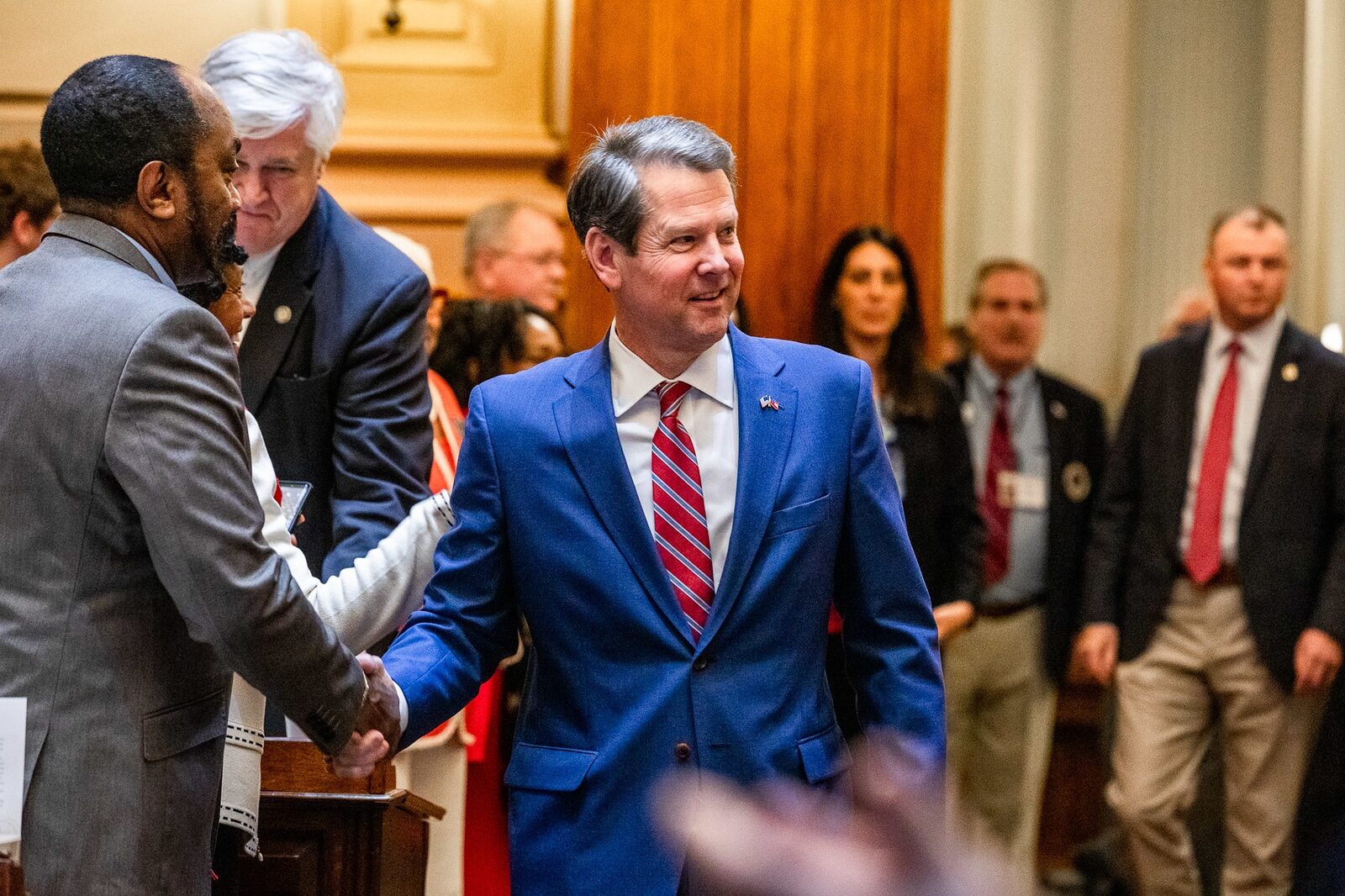
Nearly 8,000 Georgians with intellectual and developmental disabilities are waiting for state help that would allow them to live at home instead of in an institution. Lawmakers approved 900 new slots to start closing that list. Governor Brian Kemp cut that number to 100.
That is one line in a budget signed Tuesday that tells the story of who absorbed the cost of a last-minute income tax cut passed in the final hours of Georgia’s legislative session.
Who Pays
The cuts fall hardest on Georgians with the fewest options: residents with disabilities who cannot advocate for themselves, children in foster care who have no family safety net, and individuals whose medical or developmental needs leave them no private alternative.
Beyond the disability waiver cuts, children took multiple hits. More than $30 million earmarked to help school districts pay for student transportation was withheld. Pre-K expansion was cut in half — from 50 new classes to 25. Money for foster youth clothing, foster youth family placement, school nurse funding, and behavioral health training for 300 high-needs elementary and middle schools was either cut or eliminated entirely.
Healthcare took losses too. Funding for new medical residency slots was trimmed. This was one of the few initiatives the state took to improve health care this year, and was one of the healthcare-related measures Georgia’s Speaker of The House John Burns boasted about at the beginning of the year.
A wellness program for physicians facing career burnout was also zeroed out.
Who Walks Away Whole
Not all education and children’s programs were cut.
Literacy coaches in every Georgia elementary school kept their full $70.4 million. School construction held at $213 million. HOPE scholarship funding was untouched. The new DREAMS need-based college scholarship survived. Pension cost-of-living increases for state retirees were preserved.
The governor was unapologetic at a news conference Tuesday.
“We’ve got a hole in the budget that we’ve got to fix,” Kemp said. “The members who get reelected, who come back next year, when they’re dealing with the ’27 budget, they’ll be thanking us for doing this.”
The Tax Cut That Started It
The income tax cut that triggered the cuts, House Bill 463, was larger than what Kemp originally proposed. Republican legislators pushed it through in the final hours of the session, lowering Georgia’s income tax rate from 5.19 percent to 4.99 percent, raising standard deductions, and exempting some overtime and tip income from state taxes. Kemp signed it Monday — then spent Tuesday cutting programs to offset it.
Democrats were direct. Senate Democratic Leader Harold Jones II called it “another GOP tax scam that makes the rich richer,” saying middle class and working Georgians would foot the bill.
Lieutenant Governor Burt Jones, who championed the tax cut and is running for governor, praised Kemp’s decisions and used the moment to push further — calling for the complete elimination of Georgia’s state income tax.
What Comes Next
The roughly $300 million in cuts only partially closes the $1.3 billion gap the tax cut created. Budget director Rick Dunn said the state is counting on revenue growth over the coming year to fill some of what remains — with whatever is left drawn from Georgia’s $8 billion savings reserve.
The new budget goes into effect July 1.
🇺🇸 About Representing You: This is an ongoing series of news stories devoted to how the officials elected and appointed to represent you are voting, how they are spending their time and your tax dollars, and allowing you to better determine if you feel they are actually representing you or their own interests.


B.T. Clark
B.T. Clark is an award-winning journalist and the Publisher of The Georgia Sun. He has 25 years of experience in journalism and served as Managing Editor of Neighbor Newspapers in metro Atlanta for 15 years and Digital Director at Times-Journal Inc. for 8 years. His work has appeared in several newspapers throughout the state including Neighbor Newspapers, The Cherokee Tribune and The Marietta Daily Journal. He is a Georgia native and a fifth-generation Georgian.