
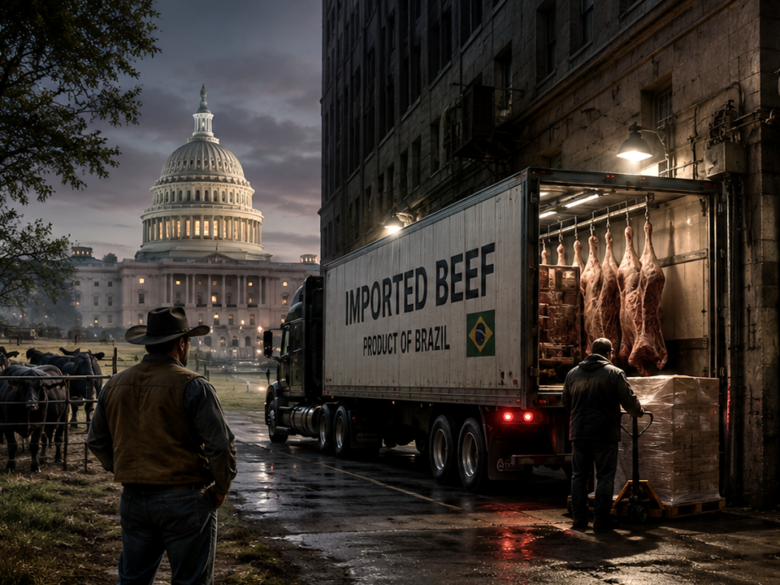
The Trump administration recently announced plans to import foreign beef in an effort to push prices downward and provide consumers relief. Yet, America’s beef problem is being presented as a relatively simple problem of supply and price. The American cattle herd is historically small, beef prices have climbed, and the people are paying more at the grocery store.
On the surface, the explanation sounds reasonable. Years of drought and rising production costs have added pressure to an already shrinking cattle herd. But government leadership is treating today’s historically small herd as though it just simply happened overnight, like Cinderella’s glass slipper.
Follow the facts backward, and a much different story emerges about how America got here and who benefited along the way.
The Historical Drag
Long before the current shortage, American cattle producers operated beneath a processing system dominated by JBS, Tyson Foods, Cargill, and National Beef, collectively known as the “Big 4.” They controlled most of the capacity through which American fed cattle had to move before reaching the beef market, creating a concentrated bottleneck as smaller and midsize processors steadily disappeared.
Beginning around 2015, evidence developed through years of legal cases reveals something considerably more consequential. The Big 4 coordinated cattle purchases and processing levels to intentionally reduce demand for cattle, weaken the prices paid to cattle producers, curb the amount of beef entering the market, and protect processor profit margins.
The real issue is what happened to American cattle producers over the last decade, what the Big 4 did to the economics of raising cattle, and how the government enabled it.
Between the Pasture and the Grocery Store
The people should be able to afford beef, cattle producers should be able to afford to raise it, and those two things should not conflict with each other. Yet the current political spin treats the cattle producer as though the price paid for the cattle is the principal variable that must be driven down for families to pay less for hamburger. That ignores the enormous economic machinery standing between them.
The Big 4 of JBS, Tyson Foods, Cargill, and National Beef dominate American fed-cattle processing and occupy the critical middle between cattle producers and consumers. These huge corporations purchase cattle from producers and sell processed beef into the consumer market, giving them enormous influence over both what cattle producers are paid and what happens to beef after processing.
Over the last decade, the cattle antitrust litigation has revealed how that concentrated power was exercised, with evidence of coordinated cattle purchasing, processing restraint, reduced negotiated purchases, information sharing, and weakened price discovery. Recently, JBS agreed to an $83.5 million settlement with cattle producers and extensive cooperation in the continuing case against Tyson, Cargill, and National Beef.
The economics are straightforward. When dominant processors collectively process fewer cattle, competition declines and producers are left holding market-ready cattle longer at greater cost. Meanwhile, less beef enters the market. Concentrated processors gain power on both sides, suppressing cattle prices while supporting beef prices, squeezing the cattleman and the consumer.
However, before the government decides the American cattle producer needs more competition, it should explain why there is not more competition for processing the American cattle producer’s cattle.
The Brazilian Connection
JBS N.V. is a Brazilian multinational and the world’s largest meat-processing company, with JBS USA Holdings, Inc. as its American subsidiary. Its operations include Swift & Company and majority ownership of Pilgrim’s Pride. JBS occupies a powerful position within America’s concentrated processing industry while operating globally, with access to beef supplies beyond American cattle producers.
JBS’s reach extends from the beef market into Washington politics, with millions spent lobbying the federal government and $5 million contributed by Pilgrim’s Pride to Trump’s 2025 inaugural committee. JBS’s government-affairs operation includes its own PAC and personnel with backgrounds at USDA, the Senate Agriculture Committee, and in congressional agricultural policy. JBS is also represented on the executive committee of the Meat Import Council of America (MICA), which works on imported-meat policy, including quotas and tariffs.
Former JBS CEO Joesley Batista lost his executive position but retained a board seat following bribery and corruption scandals in Brazil, where he was also jailed. In 2020, Batista and his brother were implicated in an SEC case involving a broader bribery scheme that American authorities said involved approximately $150 million and helped facilitate JBS’s international expansion, including its acquisition of Pilgrim’s Pride. J&F pleaded guilty and agreed to a criminal penalty exceeding $256 million.
Batista subsequently gained extraordinary access to President Trump, meeting with him over beef tariffs and later serving as his point man in delivering an ultimatum to Nicolás Maduro. Trump removed the additional 40% tariff on Brazilian beef in November 2025, while Batista later helped broker the May 2026 White House meeting between Trump and Brazilian President Luiz Inácio Lula da Silva.
JBS and Batista have extraordinary access inside Trump’s presidential orbit while enormous JBS and Brazilian commercial interests hang in the balance. The cattle producers do not have that access, but corporate big money does. No serious examination of government policy can pretend those relationships do not exist.
Big Beef Causing Less Cattle
Cattle production is a multi-year investment. Retaining heifers means sacrificing immediate income and carrying years of costs before producing additional cattle. No rational business owner continually expands when dominant buyers repeatedly demonstrate that additional production may not generate an adequate return.
Cattle production cannot respond quickly to changing markets. Decisions made today can affect cattle herds for years. When processors reduce production, market-ready cattle accumulate, costs increase, and competition for finished cattle weakens. That pressure reaches feeder cattle, calf values, and cow-calf returns, encouraging producers to retain fewer replacement females, postpone expansion, or reduce their herds.
Drought intensified the problem through damaged pastures, expensive feed, and forced liquidation. But drought struck an industry already shaped by processing concentration, disappearing alternatives, weakened price discovery, and producer-margin pressure. It accelerated the decline. It did not create the economic structure behind it.
American Cattle Economics
Rebuilding America’s cattle herd requires cattle production to be profitable enough to justify the investment. This requires prices that give cattle producers greater reason to expand herds and commit capital to producing more cattle. Instead of allowing those economics to encourage domestic production, the government is now trying to push things in the opposite direction by importing even more foreign beef at cheaper prices.
America already imports a select amount of beef each year, but importing even more does little to strengthen the American economy or support cattle producers. The issue is not simply how much beef enters the market, but who controls the path between cattle and consumers. Foreign imports add supply while leaving the concentrated buying structure untouched. The cattleman gets more competition, while the Big 4 get no competition.
American cattle producers are tied to their land, herds, costs, and years of investment, while multinational processors can source beef around the world. Without that alternative, scarce American cattle force processors to compete harder and pay producers more. Foreign sourcing gives them another option, reducing that pressure and weakening the incentive for American producers to expand their herds.
This is economic policy working against its own stated objective. America says it needs more cattle, then imports cheaper foreign beef to weaken prices while simultaneously encouraging Americans to produce more cattle faster. The multinational processor gets another source of supply, while the American cattleman gets another competitor.
More competition against the cattleman is not the same thing as more competition for processing the cattleman’s cattle.
The Political Contradiction
There is the ideology that American workers, producers, and communities should no longer be sacrificed to powerful global interests and politically connected corporations. Yet the cattle industry provides a powerful example of whether that ideology is genuine or whether corporate power and influence are greater.
In his first term, President Trump called for DOJ scrutiny of the Big 4 in 2020, followed by an investigation into potential price manipulation. Then, in his second term, he again ordered an investigation in 2025, with the White House blaming concentrated processing power for lower cattle prices, smaller herds, and higher consumer prices. That DOJ investigation has continued into this year.
Just recently, President Trump called the processing structure a “monopoly” only days after his administration moved to bring 300,000 metric tons of additional foreign ground beef into America at reduced tariffs.
In public, government leadership acknowledges the Big 4 problem and talks about antitrust enforcement, corruption, prices, and excessive concentration. However, in the back alleys and back rooms, the corporate establishment of big money and power work the political machinery while enormous financial interests stand to profit from the policies Washington adopts.
The contradiction is difficult to ignore. Government leadership says the Big Beef corporations have too much power but then proposes to address the consequences by feeding more beef through the Big Beef corporations. Ultimately, the people pay even more when the hypocrisy of self-interest masquerades as policy.
Backwards Economics
Between the American cattle producer and the people stands the backwards economics of a concentrated processing industry.
The government’s response treats the American cattle producer as the problem to be made cheaper rather than confronting the concentrated processing power standing between the producer and consumer. Government policy is placing downward pressure on the American cattle producer instead of addressing the real issues.
Cheaper foreign beef is not a solution to America’s cattle problem; it is just more foreign product flowing through the same machine that helped create it. The solution begins with confronting concentrated corporate power and creating the conditions for farmers and cattle raisers to profitably produce more cattle, processors to compete for them, and genuine competition to govern the market between pastures and grocery stores.
In the end, this is another example of competing political self-interests masquerading as a contest of principles while public policy is managed for private advantage. Yet the truth is clear: We the People are tired of the nonsense.

JJ Lewis is a constitutional conservative and independent consultant who works with businesses, nonprofits, political organizations, candidates, government agencies, and education institutions on strategy, operations, and leadership. A graduate of Tennessee Temple University, he lives in Rossville, Georgia, with his wife and family.
- JJ Lewishttps://thegeorgiasun.com/author/jj-lewis/
- JJ Lewishttps://thegeorgiasun.com/author/jj-lewis/
- JJ Lewishttps://thegeorgiasun.com/author/jj-lewis/
- JJ Lewishttps://thegeorgiasun.com/author/jj-lewis/

- Gas Prices in Georgia Are Heading Up Again
- Harris County High Baseball Coach Killed in ATV Crash
- BUSTED: Norcross man's $400K fake tax refund scam unravels
- Man found dead at Cobb County park after Valentine's Day disappearance
- Georgia's longest serving sitting college president is stepping down next year