
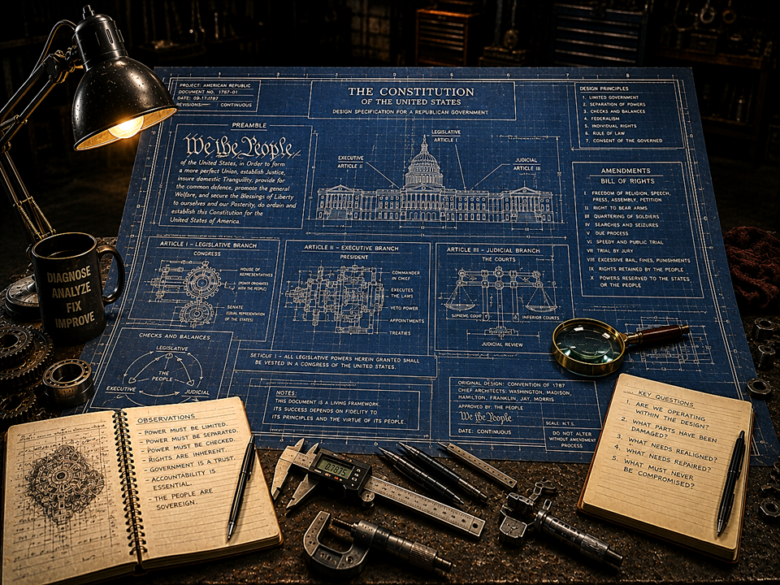
Whenever trying to understand what is truly wrong with government, the answer is not difficult to find. Most studies show that, for over 60 years, only a small percentage of people have trusted the federal government, and even fewer have believed it will do the right thing. While confidence is somewhat higher in state and local government, the pattern remains unchanged. For decades, the people have steadily lost confidence in government.
So, what is truly wrong with government, and what can be done about it?
The answer is simple in principle, yet very complex in practice. Ultimately, it comes down to those who operate the government. Politicians operate the government, corporations influence the politicians, voters put the politicians in office, and the political system keeps the nonsense going.
Think about it like a car on the road. A car is just a machine, but it does not end up in the ditch unless the person behind the wheel drives it there. Government is no different. It is a machine driven by politicians who determine where it goes. Those politicians, however, operate under the influence of corporations, special interests, and the political system that has evolved around them. Yet they do not put themselves behind the wheel. The voters put them there and keep putting them there.
Maybe it is time to look under the hood to understand what is actually broken and what it will take to fix it. But first, the people must be willing to look at things differently.
A Historical View
Over 250 years ago, America’s founders showed that transformation is borne from revolution. Americans embraced an entirely different understanding of liberty, government, and the relationship between those who govern and those who are governed. The transformation was preceded by a revolution of ideas.
Before the American Revolution, the people reached a point where they became tired of the nonsense and refused to believe that the existing system represented the only possible future. Transformation followed because their thinking changed long before their circumstances did.
However, transformation must begin with a change of mind before any lasting change can take place. People must first become willing to look at things differently. A change of mind allows people to see another way of looking at something that they may have never been shown before.
Adjusting the Perspective
Every generation has a way of looking at the world, whether inherited or developed over time. Across history, the way people look at things shapes the attitudes they embrace and the actions they take. Yet history repeatedly demonstrates that the greatest moments of progress begin when people become willing to look at things differently and question ideas that once seemed unquestionable.
Before anything meaningful changes, the people must first become willing to ask a simple question: What if we are looking at this the wrong way?
The difficult part is not finding a different way of looking at things or another perspective. The difficult part is recognizing that viewing things through the same lens for so long creates a one-sided perspective, limiting the ability to see any value in other perspectives. This is looking at everything through a lens darkly, which drives negativity, the dismissal of ideas, and prejudgment without ever considering or examining things along the way.
The Battlefield of the Mind
The challenge today is different, but no less significant. The battlefield has shifted from fields of war to the minds of the people. Modern politics has evolved into an ecosystem where conflict is rewarded more consistently than cooperation, outrage generates more attention than solutions, and emotional reactions spread faster than thoughtful ideas. Elections increasingly resemble contests for attention rather than competitions to solve problems.
Today, the people are surrounded by social media and news pipelines that stream an endless supply of manufactured outrage, controversy, and artificial urgency, so much so that constant political tension has become the new normal. Meanwhile, it seems that few actually realize they are living inside a political ecosystem designed to keep them mentally and emotionally engaged. This perpetual engagement has become part of the problem itself.
The Corporate Influence
At the center of this evolved political system sits a corporate establishment whose influence has expanded alongside the growth of modern political finance. As the barriers that limit the political influence of money have come down over the past several decades, corporations, corporate elites, and special interests have bought and paid for politicians, political parties, and much of the legislative process. Politicians become indebted to this system because it rewards fundraising, enforces party discipline, and often determines the trajectory of their political careers.
Those incentives do not emerge by accident. They exist because a vast network of political, financial, informational, and institutional interests benefits from maintaining them. Social media platforms reward emotional engagement because it keeps users’ attention. News organizations compete for audiences by highlighting controversy because controversy attracts viewers.
Land of Confusion
The consequences extend far beyond politics and elections. Public discourse has become consumed by ideological conflict and identity politics while the real work of making government more effective, strengthening people’s paychecks, improving communities, and expanding opportunity is shoved into the background. Instead of moving the people forward, the political ecosystem keeps feeding political gamesmanship that generates nothing but more nonsense.
Throughout all of this, every controversy demands immediate allegiance to one side or the other, leaving little room for thoughtful disagreement or independent judgment. The people have become so divided that they readily vilify one another, often resorting to character assassination, even within their own party. Political identity has become something people are instead of something they examine, and disagreement with an idea is too often treated as active opposition or outright hostility.
Politicasters
Political parties have tenaciously intensified the vast polarization within the political system. This has become the defining feature of this evolved modern political landscape because it has filled a vacuum once occupied by governance itself. Government is no longer judged by its effectiveness or its impact on the people, but by whether one political tribe defeats the other. In that environment, compromise becomes suspicious, cooperation becomes weakness, and governing becomes secondary to maintaining ideological loyalty.
Political organizations mobilize supporters by emphasizing conflict because conflict motivates participation. Large financial interests seek influence because influence shapes public policy. Individually these incentives may appear unrelated, but together they reinforce an ecosystem that consistently rewards division over problem solving.
Perhaps that is why so many citizens have grown weary of the entire process. Many have reached the point where they no longer see politics as a pathway to solving problems, but as an endless cycle of nonsense. Others continue participating, yet remain within the same broken system, reinforcing its polarization and identity politics. All the while, national and state political parties have shown that they care little about the grassroots until election time.
A Time for Choosing
Right now is truly a time for choosing. This is not a choice between left and right, conservative and liberal, or Republican and Democrat. Those labels dominate today’s political world, but making everything about those labels totally misses the bigger picture. None of those labels pay any of the bills or taxes in the people’s mailboxes.
The people should be less concerned with ideological branding than with whether they can afford groceries, purchase a home, raise their children, or believe that government is truly acting responsibly with the resources entrusted to it. Certainly, the people should hold strong values and beliefs that guide their lives and remain active in advancing them. Yet the people seem more divided than ever, even among those who claim the same party affiliation and share many of the same views.
The reality of today is that the people continue getting the shaft from a political system that rewards nonsense and merely just talking about how government should finally put the people first.
The Way Forward
History shows that meaningful change rarely begins inside government or its institutions. The responsibility for change and transformation rests with the people. Within the current political system, that requires rethinking the ideas that shape the political environment and determine the direction of government.
Reversing course and creating meaningful change won’t happen with most of the current politicians or political parties because they are too deeply indebted to the corporate establishment and the system. The people must become the drivers and catalysts for accountability, stewardship, and solutions rather than advancing the current system’s political theater, perpetual conflict, and nonsense. Only then will the system return to responding to the people.
All of this is not merely a suggestion in the marketplace of ideas. It is an understanding that the future can be reshaped by the people if they are willing to look beyond themselves and the manufactured political system. It also requires rediscovering their common interests and remembering that government is supposed to be of the people, by the people, for the people.
The words “We the People” should still be meaningful and serve as a reminder for every generation. The people must come together around their common interests and no longer be consumed by the twisted political machine, distorted parties, or petty differences. The truth is clear: We the People are tired of the nonsense.

JJ Lewis is a constitutional conservative and independent consultant who works with businesses, nonprofits, political organizations, candidates, government agencies, and education institutions on strategy, operations, and leadership. A graduate of Tennessee Temple University, he lives in Rossville, Georgia, with his wife and family.
- JJ Lewishttps://thegeorgiasun.com/author/jj-lewis/

- JJ Lewishttps://thegeorgiasun.com/author/jj-lewis/
- JJ Lewishttps://thegeorgiasun.com/author/jj-lewis/
- JJ Lewishttps://thegeorgiasun.com/author/jj-lewis/

- Gwinnett County police involved in shooting in Snellville
- That jellyfish in the Georgia sky this morning? It was a rocket
- Gwinnett school administrator named one of Georgia's 50 Most Influential Latinos
- Georgia deer firearms season opens Saturday
- Cherokee County man gets 35 years for sexual battery on overpass near Acworth