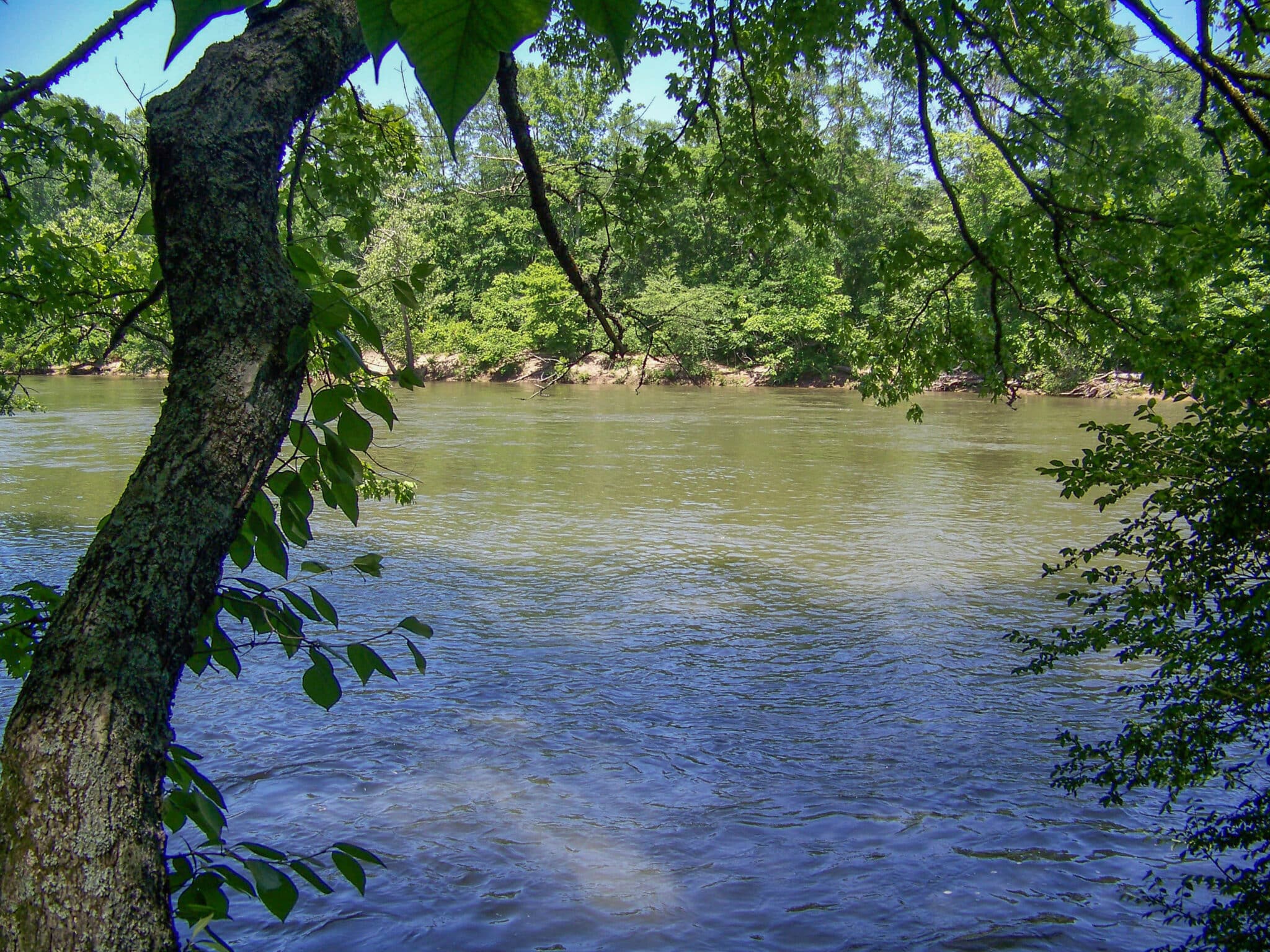
More than 44,000 fish died along a 15-mile stretch of the Chattahoochee River after Atlanta released nearly 6 million gallons of raw and partially treated sewage into a tributary last month, state wildlife investigators have concluded.
What happened: On the evening of May 20, Atlanta’s water department released an estimated 5.94 million gallons of untreated and minimally treated sewage and stormwater into Peachtree Creek through an emergency overflow pipe located about 700 feet upstream of where the creek meets the Chattahoochee River. The discharge lasted about four hours, from roughly 5:30 p.m. to 10 p.m.
The sewage overwhelmed the creek. A person crossing the Ridgewood Road Bridge over Peachtree Creek at 5:35 p.m. that evening watched the water turn black and smelled a strong odor. Video they recorded showed the creek flowing backward — upstream — from the force of the discharge. Seven minutes later, they recorded black water pouring from the outfall pipe into the creek.
The kill zone: State wildlife investigators found dead fish, black sludge coating the riverbank and river bottom, a sewage odor, and trash — including paper products, sanitary wipes, and hygiene products — along 15.74 miles of the Chattahoochee River downstream of Peachtree Creek. Upstream of the creek’s confluence with the river, investigators found no dead fish, no black sludge, and live fish still swimming.
By the numbers: State investigators estimated:
- 44,509 fish killed across 10 species
- $838,603.96 in lost fish value
- $9,599.13 in state investigative costs
- $848,203.09 total
The largest numbers by species: 16,669 sunfish, 7,270 catfish, 6,562 shad, 4,965 black bass, 4,965 sucker-type fish, and 2,128 striped bass. Rainbow trout, bullhead, yellow perch, and minnow-type fish were also killed. By dollar value, sucker-type fish accounted for $354,629, striped bass for $279,572, and catfish for $125,041.
What killed the fish: The sewage stripped oxygen from the river. A federal water monitoring station near Fairburn, about 20 miles downstream, recorded dissolved oxygen dropping to 1.5 milligrams per liter beginning around 5 a.m. on May 21 — about eight hours after the discharge ended. Fish typically cannot survive when dissolved oxygen falls below about 3 milligrams per liter. Levels recovered above 6.0 milligrams per liter by 9:30 p.m. that night.
The river was already weakened by drought. Flow near the Peachtree Creek confluence measured about 910 cubic feet per second immediately before the spill — a low level that left less water to dilute the sewage.
The timeline:
- May 20, ~5:30 p.m.: Sewage discharge begins at the emergency outfall on Peachtree Creek
- May 20, ~10 p.m.: Discharge ends after about 248 minutes
- May 21, ~5 a.m.: Dissolved oxygen begins dropping at the Fairburn monitoring station, reaching 1.5 mg/L
- May 21, 8:15 p.m.: A citizen reports black water and dead fish near Riverview Road and Veterans Memorial Highway, about 4 miles downstream of Peachtree Creek
- May 21, 9:30 p.m.: Dissolved oxygen rebounds above 6.0 mg/L at the Fairburn station
- May 22, ~7:30 a.m.: Jason Ulseth, Executive Director of the Chattahoochee Riverkeeper, reports thousands of dead fish to state authorities after observing them by boat
- May 22, ~11:25 a.m.: State wildlife investigators arrive with three boats and begin the field investigation
- June 8: Atlanta’s water department reports the discharge to state environmental regulators
- June 12: Atlanta’s water department provides the 5.94 million gallon estimate to regulators
What’s new: Atlanta’s water department did not report the May 20 discharge to the Georgia Environmental Protection Division until June 8 — 19 days after the spill. The city provided its estimate of how much sewage was released four days after that. State wildlife investigators have formally concluded the sewage discharge caused the fish kill.
The path forward: The investigation report has been submitted to the Georgia Environmental Protection Division. No charges or penalties have been announced.
Back in the day, adulthood meant civility. Responsibility. Probably owning a sensible pair of loafers. But lately, it feels like a critical mass of humanity has collectively decided, ‘What if, instead, we didn’t?’
 Buy the Book on Amazon →

B.T. Clark is the Publisher of The Georgia Sun and author of Principles Are Like Pants… You Ought to Have Some. Over two decades in journalism, he has served as Managing Editor of Neighbor Newspapers in metro Atlanta and Digital Director at Times-Journal Inc., earning multiple awards along the way. His work has appeared in newspapers across the state, including The Cherokee Tribune and The Marietta Daily Journal.
- B.T. Clark

- B.T. Clark

- B.T. Clark
- B.T. Clark