
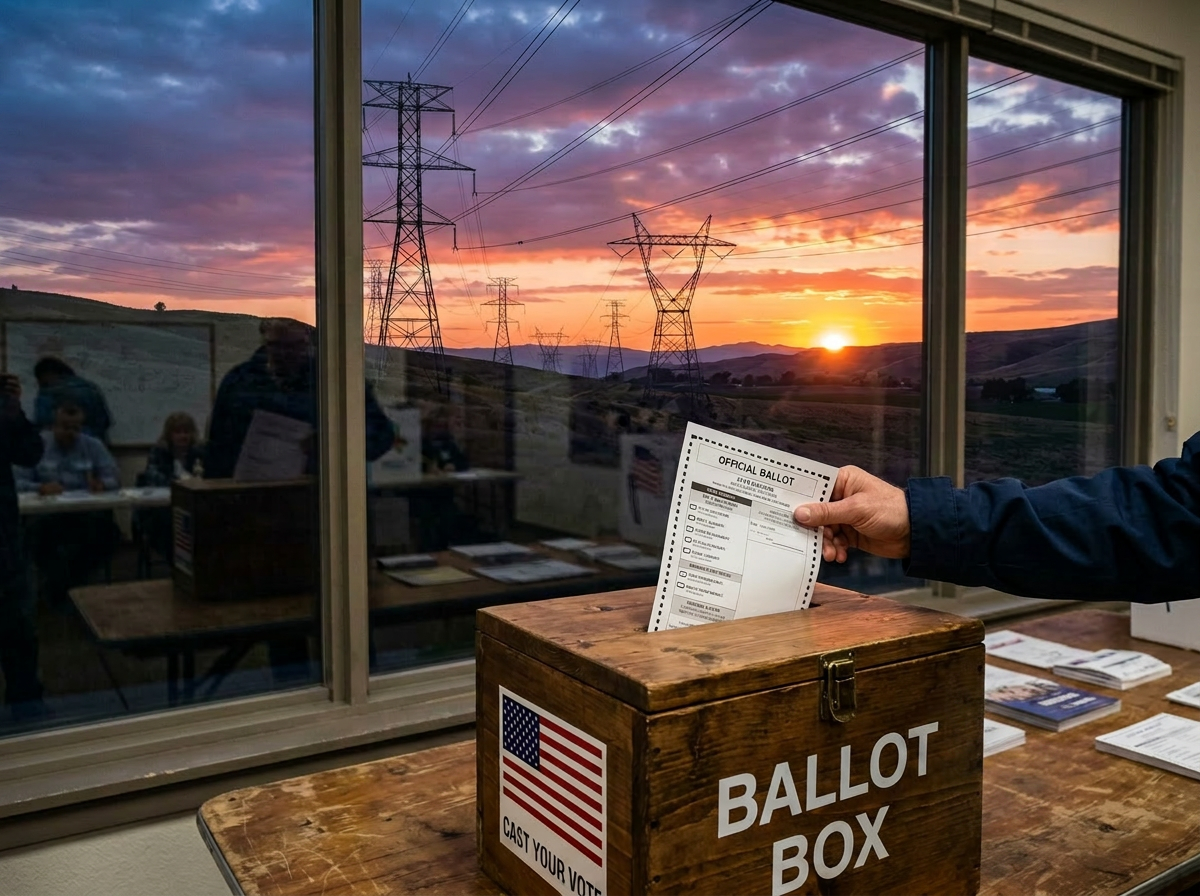
An election on the Republican ballot Tuesday goes to the core of two overarching concerns during this election cycle: affordability and data centers.
The five-member Georgia Public Service Commission does not decide whether technology companies can build their data centers, which consume land to house their computer servers, often use water to cool them and consume copious amounts of electricity to power them.
But the elected commission members’ decisions can affect the companies’ cost of doing business by controlling electricity rates and, by extension, the amount of money that regular customers pay to cool, heat and power their homes and businesses.
Candidates on both sides of the aisle have talked of the need to contain rising consumer bills after a half dozen increases in recent years were blamed for Republicans’ loss of two seats on the commission last year.
The commission can control electricity rates through its regulatory authority over Georgia Power, a monopoly energy producer.
The challenge for affordability-minded voters: how to pick the candidate commission for District 5 who can do more than talk a good game.
Democrats have already settled on their choice, sending Shelia Edwards of Cobb County to the November general election.
Republicans have more work to do, after two of their candidates emerged from a field of three in the May 19 primary.
Engineer Josh Tolbert and businessman Bobby Mehan won the most votes, but neither had the majority required to avoid a runoff.
Tolbert came close, with about 47% of the vote to Mehan’s 31%.
Mehan, of Haralson County, has pitched his executive resume as the right preparation to deliver affordability, saying his former leadership of a small global health care technology company and his current roles as managing partner of a local private equity firm and state mediator have conferred the skills to deliver on an unequivocal promise.
“Throughout this campaign, I have cast a clear vision: no new rate increases,” Mehan said at a Georgia Public Broadcasting debate with Tolbert in late May, repeating a prior promise.
Tolbert has positioned himself as a technical expert, saying his four engineering degrees, including a doctorate in mechanical engineering, combined with his professional experience, including as chief technology officer of a small nuclear power company, make him the best choice to rein in costs.
“I’ve designed power plants. I’m a small business owner that can connect technical choices with economic outcomes. This is expertise the Public Service Commission needs,” Tolbert said at that same debate.
Tolbert said Mehan was offering more of the same policies that allowed Georgia Power to increase costs for its customers in recent years.
The commission approved a half dozen rate increases when all five members were Republican, which may have precipitated the ouster by two Democrats last year.
“My opponent says that what we need is more non-technical people on the commission. But if we approach the problem in the same way we always have, we should expect the same result,” Tolbert said at the debate. “This job is technical. It’s time we send an engineer to do it.”
He said his expertise would empower him to ask insightful and hard-hitting questions that the commission could use in negotiations with Georgia Power to push back against pressure to let the company increase customer bills.
Tolbert said Mehan’s hard line against any rate increase was unrealistic, an empty slogan to win the election.
Mehan said his executive decision-making skills would allow him to judge guidance offered by the commission’s own experts, which he said he would rely upon, and that Tolbert’s approach would be slower than a blanket denial on rate increases.
“If technical scrutiny is what Josh is saying that we require to keep the Republicans in power in this seat, then that sounds like to me, that’s going to be more time. Time is money,” Mehan said. “If affordability is the number one issue to voters, then I think we’ve got to figure out how to do this and do this quickly. … If there’s anything that I’m good at, it’s the top-line growth.”
Both said they like nuclear power as a clean and reliable energy source, but they said new plants would be too expensive to build for the foreseeable future. Both said they back solar power and other renewables, but both also say fossil fuels must remain part of the mix due to their large share of Georgia Power’s portfolio.
Whoever wins the runoff will face an opponent who took nearly 56% of the vote during the three-way Democratic primary. Edwards said her background in writing technical documents for NASA had prepared her to help the commission contain customer costs.
Were she to win, she would flip a longtime Republican seat, joining the other two new Democrats to establish a Democratic majority on the commission.
Edwards said at a Georgia Public Broadcasting debate in April that a commission led by her and the other two Democrats would discourage Georgia Power from requesting unreasonable rate increases.
“We’re taking mothers and children off welfare, but we’re steadily giving these corporations corporate welfare and that needs to stop,” she said. “We have to have those conversations with Georgia Power. And I think they’re going to turn around to be reasonable people when I’m on the PSC as the third vote.”
This story available through a news partnership with Capitol Beat News Service, a project of the Georgia Press Educational Foundation.

Ty Tagami is a staff writer for Capitol Beat News Service. He is a journalist with over 20 years experience.
- Ty Tagami | Capitol Beathttps://thegeorgiasun.com/author/ty-tagami-capitol-beat/
- Ty Tagami | Capitol Beathttps://thegeorgiasun.com/author/ty-tagami-capitol-beat/

- Ty Tagami | Capitol Beathttps://thegeorgiasun.com/author/ty-tagami-capitol-beat/

- Ty Tagami | Capitol Beathttps://thegeorgiasun.com/author/ty-tagami-capitol-beat/
- 76-year-old ex-wife charged with murder after two people were found dead in a Georgia home
- Have you seen these three missing Georgia teens
- Cat dies in Roswell basement fire
- Wildfire danger is high across much of Georgia today
- The Northern Lights Are Coming South Again Tonight: When to See Them in Georgia