
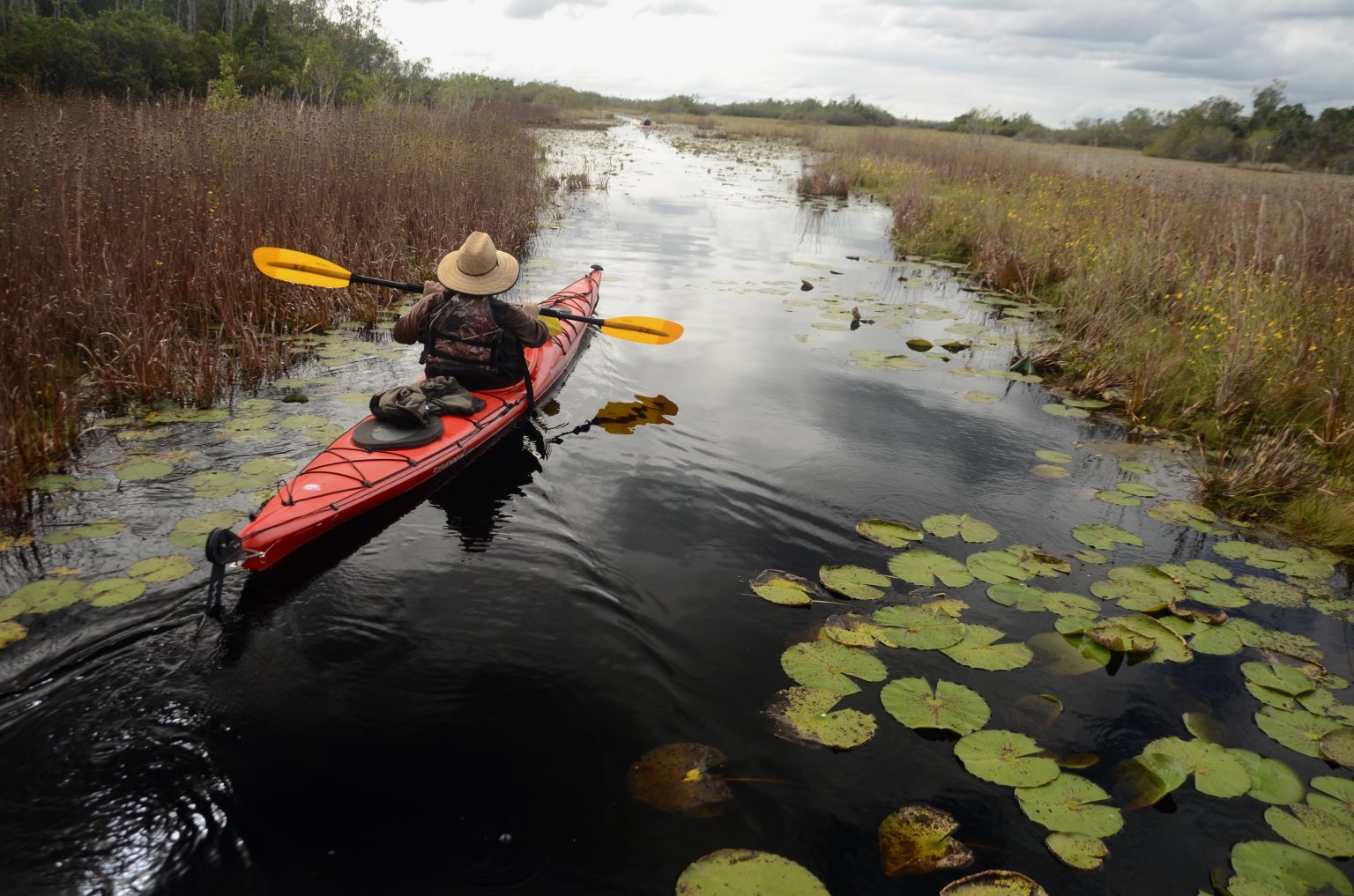
Fresh off the world stage with the departure of FIFA World Cup fans, Georgia is back in the limelight with the listing of the Okefenokee Swamp as an international treasure.
The United Nations Educational, Scientific and Cultural Organization announced Saturday that it had decided to add the Okefenokee National Wildlife Refuge to its World Heritage Site List.
The decision, reached during the 48th World Heritage Committee session in Busan, South Korea, makes the swamp the first such site in Georgia and the first listed national wildlife refuge in the United States, which already has more than two dozen listed sites.
“Receiving World Heritage status affirms what those of us who know and love the Okefenokee have always believed: this place is special,” Kim Bednarek, executive director of Okefenokee Swamp Park, said in a statement while attending the committee session.
Tracie Revis, a citizen of the Muscogee (Creek) Nation, delivered a statement on behalf of Chief David W. Hill, in the languages of her two tribes, Muscogee and Yuchi. She said in a phone interview from Busan that she expressed excitement for both the natural wonder of the Okefenokee and for the lives of her ancestors who lived there before they were forcibly removed from the land.
The designation “gives us a larger platform to showcase not just the biological side of things, but the cultural side of it,” Revis said.
Okefenokee advocates say the designation also will put South Georgia on the global map as a tourist destination, boosting the regional economy.
Gov. Brian Kemp said in a statement that it was “a fitting recognition for the Okefenokee that will further strengthen rural communities that surround it.”
A 2024 study said a World Heritage listing would draw 800,000 tourists a year, doubling visitation and creating about 750 long-term jobs and about $60 million in annual economic impact.
U.S. Sen. Jon Ossoff said in a statement that the designation “will help protect this renowned natural treasure for generations to come, promote tourism, and support Southeast Georgia’s economic growth.”
The Okefenokee is the first U.S. natural World Heritage Site added in more than three decades and brings the number of World Heritage sites in the country to 27.
Other natural sites include the Grand Canyon, Yosemite and Yellowstone in the United States, and the Great Barrier Reef, Mount Kilimanjaro and the Galapagos Islands beyond.
Sites can also have cultural value, such as the Statue of Liberty, the Great Wall of China and the Taj Mahal.
The swamp’s mass of floating peat deposits makes an unstable surface for walking. It led to the swamp’s name, often translated as “land of the trembling earth” from the Muscogee language.
It also played a role in UNESCO’s decision, according to Bednarek’s group, which said the World Heritage Committee recognized the swamp for its ecology, biodiversity and the scale of its subtropical freshwater peatland ecosystems.
A group called Georgia Rivers said it facilitated a study of carbon storage in the peat that established the “Outstanding Universal Value” required to support a World Heritage bid.
Rena Ann Peck, executive director of Georgia Rivers, attended the committee session in Busan with Bednarek. She said she hoped the designation would encourage more swamp visitors.
The swamp has the largest undisturbed peat deposit on the North American Coastal Plain. It is also home to more than 1,200 species of animals and plants.
And it has mineral wealth that industry would like to tap.
For years, a threat loomed at the edge of the swamp, as a company called Twin Pines Minerals sought to mine titanium dioxide. Then, last year, that threat was neutralized when a group called The Conservation Fund assembled about $60 million to purchase the nearly 8,000-acre property.
But other properties nearby could also host a mine.
Researchers at the University of Georgia released findings late last year that showed how harmful this could be to the swamp.
Mining requires significant amounts of water. The mines would draw it from an aquifer deep below the swamp, under the assumption that an intervening layer of clay separates the swamp from the aquifer.
The UGA research found otherwise, tracing water isotopes and discovering that water from the swamp appeared to be draining into the aquifer. Their conclusion: mining would drain the swamp.
Meanwhile, political pressure was building to protect the Okefenokee.
Ossoff, a Democrat, and others from Georgia’s congressional delegation, urged the Department of the Interior to pursue the World Heritage designation.
Then, last year, University System of Georgia Chancellor Sonny Perdue, who had previously been the state’s first Republican governor in more than a century and a former Cabinet secretary for President Donald Trump, joined the campaign. He asked Interior Secretary Doug Burgum to seek the World Heritage designation because, Perdue wrote, it would “preserve a national treasure while also delivering incredible economic benefits to the state of Georgia.”
The group Environment Georgia noted that more than 30,000 acres adjacent to the Okefenokee remain eligible for mining.
“This World Heritage Site recognition affirms what so many Georgians already know — the Okefenokee is a natural treasure,” Jennette Gayer, the group’s Georgia director, said in a statement. “We call on our leaders to ensure this special place, a wonder of the world, is protected from the threats of mining.”
Revis predicted that placing the Okefenokee on a world stage will generate more support for protecting it, “which can sometimes add pressure if we need it down the road.”

Ty Tagami is a staff writer for Capitol Beat News Service. He is a journalist with over 20 years experience.
- Ty Tagami | Capitol Beathttps://thegeorgiasun.com/author/ty-tagami-capitol-beat/

- Ty Tagami | Capitol Beathttps://thegeorgiasun.com/author/ty-tagami-capitol-beat/

- Ty Tagami | Capitol Beathttps://thegeorgiasun.com/author/ty-tagami-capitol-beat/

- Ty Tagami | Capitol Beathttps://thegeorgiasun.com/author/ty-tagami-capitol-beat/