
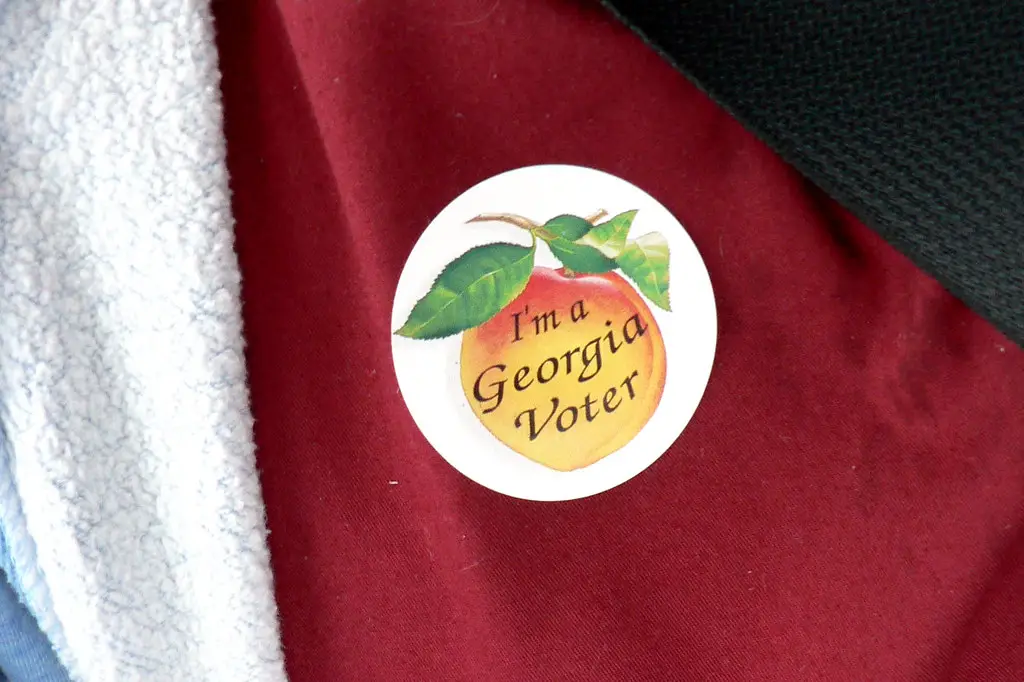
After the state saw a recording-breaking turnout in 2022 — drawing more than 1.9 million voters to the primary — Georgia saw another surge in 2026 as runoff participation climbed far higher than usual. Election officials have pointed to this data as evidence that Georgians remain deeply engaged heading into another closely watched election season.
But beneath the encouraging numbers lies a stark imbalance: young voters are still barely showing up.
Youth Turnout Remains Strikingly Low
Despite the surge in participation, voters aged 18 to 29 make up less than 6% of all ballots cast, according to public voter data. Meanwhile, more than half of votes come from Georgians 65 and older, and nearly 30% of votes come from those ages 50-64.
There is no age group under 50 that accounts for more than 10% of the total votes.
The numbers suggest that Georgia’s elections — from local school boards to statewide offices — are being decided overwhelmingly by older residents. Younger Georgians, who make up a large share of the state’s population, remain largely absent from the democratic process.
Why Young Georgians Aren’t Voting: Voices from Athens and Beyond
To understand the gap, three young men living in or connected to Georgia shared their perspectives on why they don’t vote consistently in state or local elections.
Ryan Hamby — a 21-year-old resident of Athens — voted in the 2024 presidential primary, but he chose not to vote in the 2026 primary. His reasoning reflects a deep disillusionment with both parties.
“The past four years, it doesn’t matter who you vote for — the same agenda is pushed.”
Hamby says neither party has delivered on its promises “to the extent they said they would.” He points to President Trump as an example:
“He wasn’t catering to the same audience in office as he was during the campaign.”
Hamby said he cares more about local elections, voting for county commissioners and the sheriff in Morgan County. But statewide races? He’s checked out.
“Politics is a reality TV show. I used to think it mattered. Once I actually paid attention, I figured out it doesn’t.”
When asked what kind of candidate would motivate him to vote again, he didn’t hesitate:
“Someone elected without a doubt of cheating. Somebody putting in the work to change things that actually need to change — not listening to lobbyists and making money their god. Someone with a backbone.”
Gianluca Corrias — a 21-year-old student at the University of Georgia — votes in presidential elections, but he has never voted in a midterm, though he plans to this year.
He doesn’t vote for local officials, and he admits he has no specific reason why.
“I’m indifferent to voting in general,” said Gianluca.
He says he believes voting is important, but he also thinks there’s truth in the idea that a single vote doesn’t make a difference.
“It’s not a reason to not vote, but it’s true.”
Gianluca says he doesn’t know what would need to change to get him more involved. He says he believes local elections matter more than presidential ones, but he says he doesn’t feel their outcomes affect his daily life.
“If voting had a real effect on day-to-day life, more people would participate.”
Tim Monohan — a recent graduate of Mississippi State University — did not vote in the 2024 presidential election. He also did not vote in the 2022 nor the 2026 primaries.
He says he hopes to vote in the 2026 midterm this fall, but he admits he’s not planning on it, even though he says he feels he should.
“I’m too consumed with life circumstances.”
Monohan doesn’t vote in state elections, because he moves often. He was raised in Tennessee, attended college in Mississippi, and is moving to Florida this fall.
“I don’t have a personal tie to any state,” Monohan said.
He says he plans to participate more once he settles down.
Monohan says he believes an individual vote “means little” and is indifferent to voting overall.
“I wish I cared more, but there’s no pressing need for me to right now.”
Why This Matters
Young voters often say their vote doesn’t matter. But Georgia’s recent history shows the opposite: many elections are decided by margins so small that even a handful of young voters could flip the result.
Here are the most striking examples:
Georgia House District 28 — 2018
The May 2018 Primary was decided by 67 votes.
A judge found that dozens of voters received the wrong ballot, so the election was thrown out.
A re-run election was held in December of the same year, and the results were decided by 16 votes.
Sixteen votes is the size of a classroom, a church youth group, or one extended family. Any small group of young voters could have changed the outcome.
The administrative errors and legal battles surrounding District 28 became a statewide embarrassment, a case study in how fragile elections can be when turnout is low and margins are razor-thin.
Georgia House District 99 — 2022
Three ballots decided a legislative seat.
Georgia House District 117 — 2022
The voting margin in this election came down to 25 votes — a neighborhood’s worth of voters could have flipped the result.
The Bottom Line: Young Non-Voters Are Deciding Elections — By Not Showing Up
Georgia’s 2026 turnout surge shows that voters are engaged, but the data makes clear that young Georgians are not yet part of that story.
When elections are decided by margins as small as 3, 16, or 25 votes, the absence of young voters becomes more than a demographic trend. It becomes a decisive force.
If even a fraction of Georgia’s 18 to 29 population voted consistently, they could flip close legislative seats, influence statewide policy priorities, reduce the likelihood of contested elections, and shift the balance of political power in a state where margins are often razor-thin.
Georgia elections are being shaped by those who show up.
Right now, young voters are letting others decide for them.

Anna Takle is a writer for The Georgia Sun and a recent graduate from the University of Georgia. She is passionate about blending her background in psychology with understanding the community around her, seeking to keep the public informed and connected. Reared in Pike County, Georgia, she enjoys time on her family farm, blogging, and writing newsletters for Eagles Way Church in Griffin.
- Anna Taklehttps://thegeorgiasun.com/author/anna-takle/
- Have you seen these three missing Georgia teens
- Driver dies after runaway tire hits two cars on I-75
- Wildfire danger is high across much of Georgia today
- 76-year-old ex-wife charged with murder after two people were found dead in a Georgia home
- Georgia Supreme Court sends child neglect case back to lower court