
In the world of American politics and government today, there is a growing crisis beneath the everyday noise. When separated from the nonsense of headlines and social media blowharding, people across the country keep circling back to the same blunt question, one that is widely asked but rarely answered: What is actually wrong with politics and government?
This question shows up in workplace conversations, around dinner tables, and in quiet moments when voters are deciding the important things in life. The frustration cuts across party labels.
These questions cut across parties and ideologies. Whether Republican or Democrat, conservative or liberal, red state or blue state, the pattern is the same: people increasingly feel disconnected from a political system and a government that claim to represent them but rarely act in their interest.
This is not simply about disagreement or polarization. Americans have always been able to disagree. What people are reacting to is something deeper: a growing belief that modern politics is no longer anchored in legitimacy. As fairness, accountability, and meaningful representation fade, the entire system begins to crack.
Polarization is a Symptom, Not the Disease
The most common explanation for political dysfunction is polarization. The country is deeply divided, and extremes dominate political discourse. While this is true, it is incomplete. Polarization is not the root problem; it arises when people no longer believe the system represents them fairly.
When the political system works, disagreement produces debate, negotiation, and compromise. When it fails, disagreement hardens into identity and resentment as people lose faith that they are represented fairly. Outrage-driven media amplifies extremes, and politicians lean into conflict to mobilize donors and voters. The collapse that follows is not caused by public apathy, but by the belief that the political class no longer works for the people.
This is not a system failing to govern. It is a system sustained by corporate money and manufactured conflict. Arguments recycle, problems remain unsolved, and representation exists more as branding than reality. Polarization is not the disease; it is the business model. What appears to be chaos is routine, and what feels like division is the result of a political class that stages disagreement while safeguarding the same outcomes.
When Governance Becomes Theater
At some point, politics crossed a line. Elected officials stopped acting primarily as problem solvers and started behaving like performers. Messaging replaced governing. Optics replaced results and responsibility. When politicians are just actors, government has become theater.
People are not disengaged because they do not care. They are disengaged because they recognize the script. Speeches are written for cameras, outrage is staged for fundraising, and votes are symbolic because nothing is meant to change. American government stays locked down because moving real solutions forward threatens the political incentives that keep politicians in place.
The Influence of Money and the Price of Admission
One of the clearest signals that legitimacy is breaking down is the role of money. Campaigns are expensive to the point of absurdity, and sometime there is more time spent fundraising than actual governing. Access follows donations and influence follows access. Ordinary voters see this clearly, even when it is dressed up as normal.
Big money is the filter for political office. Serious candidates without money or donor dependence opt out, while those most comfortable with fundraising, media attention, and ideological signaling rise. Too often, the system rewards politicians who are already bought and paid for.
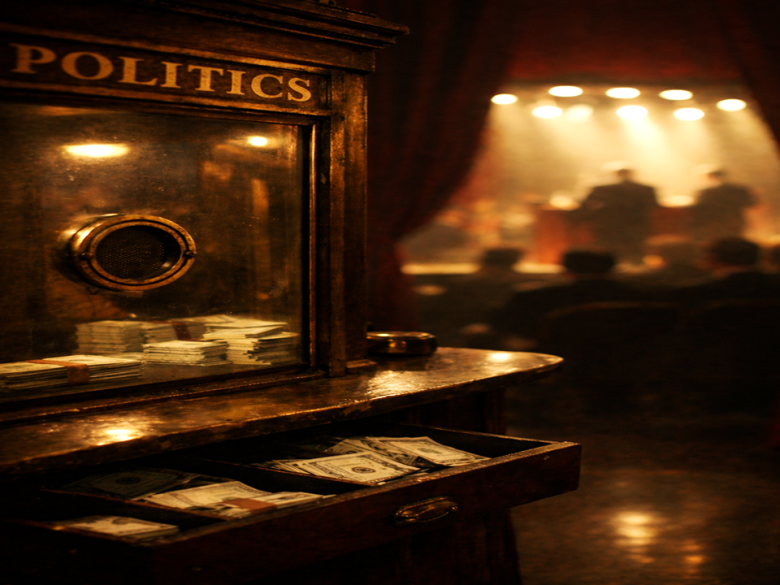
This is politics as theater. It creates the illusion of action while delivering none of the substance. Costs rise, systems strain, and infrastructure decays, yet the political class stays busy performing for cameras and donors. For working people, the vote has become nothing more than the price of admission to watch corporate- and lobbyist-funded actors recycle the same script.
Politics is no longer done with or for the people, as politics is now done to them. This is how the system selects the wrong people. It rewards money and donor loyalty over competence and accountability. The problem is less overt corruption than structural dependence. When survival depends on money, priorities follow.
An Ecosystem That Rewards Money
The problem does not stop with fundraising. Party gatekeeping, primary structures, and internal power dynamics further narrow the field. Candidates who challenge the status quo often face institutional resistance before voters ever hear from them. Endorsements, ballot access rules, and party machinery tilt the playing field long before Election Day.
In many states, district design and low-turnout elections allow primaries to decide most outcomes, collapsing accountability. Elected officials fear party challenges more than voters, pushing the system toward ideological survival instead of problem-solving.
Ultimately, this creates an ecosystem that rewards money, donor loyalty, and purity while pushing out independence and long-term thinking. Effective leaders often opt out or lose because the system is not designed for them to succeed.
Broken Processes and the Illusion of Choice
Many voters sense that elections no longer feel like real choices. Noncompetitive districts mean outcomes are often predetermined. Primary systems exclude large portions of the electorate. National mechanisms are increasingly criticized for failing to reflect majority preferences. Whether one agrees with all of this or not, the perception of the people matters.
Legitimacy is not just about rules on paper; it is about whether people believe the rules are fair and meaningful. When large numbers of citizens feel their participation changes nothing, cynicism becomes rational. Voting starts to feel like validation rather than influence.
This is how indifference grows alongside anger. People oscillate between outrage and withdrawal because neither seems to move the system. The belief takes hold that government serves a few powerful interests rather than the public at large. Once that belief hardens, trust becomes extremely difficult to rebuild.
Constant Aggression and Short-Term Power
Political tone matters. Aggression, demonization, and escalation do more than poison discourse; they signal that norms no longer apply. When leaders model contempt and treat opponents as enemies, trust collapses.
At the same time, many voters see leaders chasing headlines instead of confronting long-term challenges. Economic strain, infrastructure needs, and institutional reform demand seriousness and political risk, but are often deferred.
The effect is corrosive by design. Politics no longer feels unstable by accident; it feels detached from shared rules because those rules get in the way of power. Legitimacy is stripped regardless of intent, because intent no longer matters.
A government by the people was never about politeness. It was meant to restrain power. Today, that restraint is failing. What remains looks less like self-government and more like managed consent, where working people are invited to participate just enough to legitimize outcomes already decided by money, institutions, and interests that do not answer to them.
The Two-Headed Uniparty Snake
Many voters look at the federal government, and increasingly at state and local levels, and conclude that the differences between parties are largely surface level. Beneath the branding, they see the same incentives, behaviors, and power structures shaping outcomes. This perception spans ideology and defines how many now view government as a whole.
Americans who remain actively engaged in politics are aware and far from being stupid. They do not believe every politician is identical, but they do believe something more troubling: that the system overwhelms individual intent. When the same behavior is rewarded, the same outcomes follow, regardless of the messaging.
What emerges, in the public mind, is not a healthy two-party system but something closer to a uniparty culture, where the political machine competes over messaging rather than results, disengagement becomes an indictment of the system.
The Real Crisis Is Legitimacy
At the center of all of this is legitimacy. When political power no longer fears the people, elections become permission slips rather than accountability. Trust in the system has eroded, and real accountability and meaningful participation are slipping away. What is truly lost is the belief that the rules apply equally and that outcomes reflect the will of the people, not the influence of power.
As legitimacy fades, polarization intensifies, money dominates, norms erode, and governance stalls. These failures are interconnected consequences of a system people no longer believe works for them. The problem is not mysterious. The system has drifted away from the public, and the working people feel it every day. Without legitimacy, disagreement no longer feels productive or meaningful.
The response for the people is neither withdrawal nor blind loyalty. It is sustained accountability. The only true leverage voters retain is the willingness to replace those who preside over failure. Vote them all out, again and again if necessary, because systems only change when those in power feel the true pressure from the people.
Note: This is an opinion article as designated by the the category placement on this website. It is not news coverage. If this disclaimer is funny to you, it isn’t aimed at you — but some of your friends and neighbors honestly have trouble telling the difference.
- Rockmart fast food restaurant fails health inspection with a score of 65
- Police arrest 2 teens after Marietta parking lot shooting
- Missing Children: Search Underway For 2 Sisters Who Got Into a Gray SUV in Augusta
- Here's who is running in Georgia's statewide elections
- 10 Cool Ways To Grow Your $1,000