

When Georgia lawmakers return to Atlanta for the new legislative session, they will proceed to their weathered wooden desks, and if they are observant, they will notice something new.
The carpeted floor will offer a little more give, and the old stains will be gone.
When they reach their desks, some will bend to the floor to plug in their laptops, as they have long done. But someone will point out that they no longer need to: the old desks now have modern outlets — not just a standard power plug but also a USB-A connector, and even a future-proofed one for USB-C.
Then, other details will register, and it will become clear this is not exactly the same place they left in April.
The fireplaces (unused these days) now have hearths of marble, salvaged from the old state Supreme Court building after the new one was erected nearby.
Perhaps most obvious: the wooden chairs now carry their weight without creaking or worry.
And if lawmakers and visitors were to lift their eyes to the ceiling high above, they would see something that was never there before: gold, real gold.
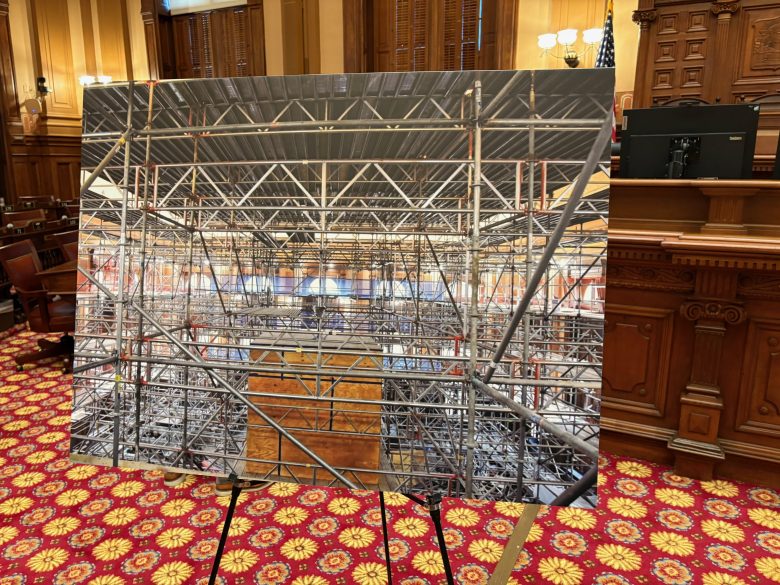
When they were last here, the ceiling was decorated with gold-colored paint. Now it is adorned with gold leaf, applied by a restorationist hoisted high into the air on a platform supported by tons of steel scaffolding.
Like many of the more than 550 artisans and other workers who renovated the Capitol over the past eight months, the gold leaf was from Georgia, said Gerald Pilgrim, the state official who oversaw the face lift. “We actually have the receipts from Dahlonega.”
The carpet is native, too, from the weave masters in Dalton.
Both were line items in a restoration budget that totaled about $82.5 million, with about $10 million for furniture and similar things and the rest for construction, said Pilgrim, chief of staff at the Georgia Building Authority.
The work started in early May, a month after lawmakers finished their last legislative session. And the bulk of it was completed in time for their return this week, though there are a couple more phases to go.
Some of the most consequential work will be invisible to the lawmakers and to the observers who come to watch them, though repeat visitors might sense a difference. For one thing, the HVAC system is new. Pilgrim said it was the most challenging task, since it was the first significant update since the 1950s, around the time Americans started seeing color in their televisions.
The workers also laid 133,000 feet of wiring under the floors to connect all the new systems. In addition to those modern outlets at legislators’ desks, there is a sound system in the visitors’ gallery above them, for the hard of hearing. Workers also removed some of the fixed seats there to make room for wheelchairs.
From where visitors sit, they would be hard-pressed to notice one major upgrade that will quickly become apparent to the representatives and senators below.
The legislators used to play musical chairs, swapping out their own failing seats for functional furniture from a nearby and likely unobservant desk mate (no doubt one from the opposing party). They needed sturdy support for their 40 days and many nights of making laws.
“There was a lot of stealing chairs,” Pilgrim said. Some were unsafe, “put together literally by toothpicks” and beyond repair, he said, adding that they should have been replaced half a century ago.
The new ones may not be authentic, but they can perform their duty safely, perhaps until the next renovation. The Building Authority kept the old ones in storage but got a 20-year warranty on their replacements.

“This year, your lawmakers have been fighting the good fight and it looks like before the end of the day on Friday cornbread will finally be the official bread of Georgia.”