
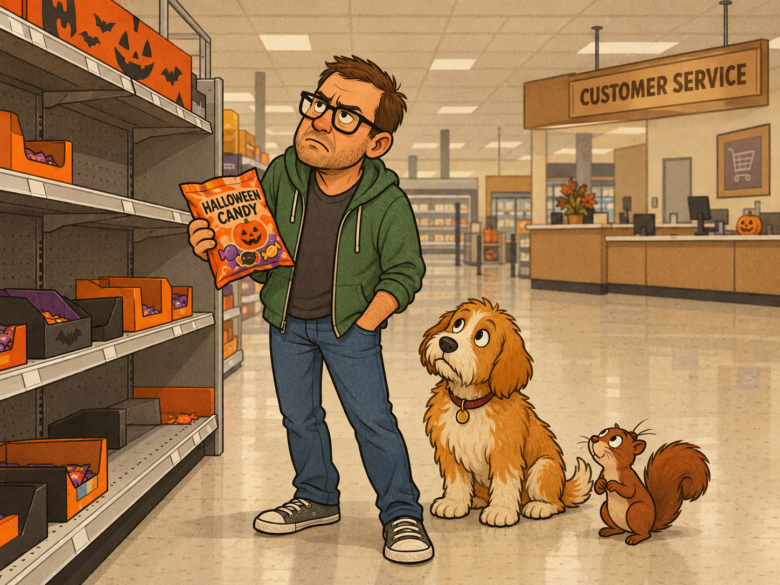
I went to the grocery store today. Twice. On a Sunday. In October. If you’ve ever done that, you already know this column is going to be a tragedy.
The first trip was for Halloween candy. Simple enough. I got in, grabbed what I needed for a church event we were bringing candy to, and got out feeling pretty good about myself. When I returned to the car from my successful mission, my wife patiently reminded me that peanut allergies exist and informed me that I would have to return what I just bought to get something more appropriate for all God’s children.
It was during this second go-round that my nightmare truly began.
I won’t name the store, that wouldn’t be decent, but I will say it has an animal in its name, and I ain’t lyin’ about that.
Now, because I needed to make a return, self-checkout wasn’t going to cut it. I had to find an actual human being employed by this establishment, which, as it turns out, is a taller order than it sounds. It’s Sunday, the last chance for everybody doing their weekend shopping to get it done. And staffing that entire operation? Three cashiers. Three. For a store the size of a small aircraft hangar.
All three lanes were full, naturally. So I got in line and began what I can only describe as a descent into hell in slow motion.
The first thing I noticed is that this is one of the many grocery stores who has decided to eliminate the lowly but important position of “bagger.” For the stores that have done this the math doesn’t work in their favor, even if they think it does. When a cashier has to stop after each item or every four items to bag, every single item, the whole operation slows to roughly the pace of continental drift. The cashier is doing two jobs, which makes each job twice as slow, which makes the overall checkout experience something like four times longer than it needs to be. You spend an hour shopping, and then you spend forty-five minutes in line watching someone carefully fold a bread bag before placing it gently into a plastic sack.
And what does the store save by eliminating baggers? A couple hundred dollars a day, maybe. That’s it. That’s the trade-off. Forty-five-minute checkout lines, miserable customers, and overworked cashiers — all to save what amounts to the cost of two or three grocery orders.
My wife was a cashier at Kroger when we were teenagers. She was fast. I mean, impressively fast. I had the pleasure of going through her lane a couple of times before we were dating. It was a sight to behold. The cashier I had today was operating at approximately one-tenth her speed. I don’t say that to be cruel. I say it because that cashier was also bagging, which means she wasn’t hired to be slow — she was made slow by a system that decided her labor was worth doubling without any corresponding increase in compensation or staffing.
When I finally reached the front of the line and explained I needed to make a return, I was pointed toward the customer service desk. The customer service desk, of course, had no one at it. I assumed the cashiers were covering customer service as a third job on top of everything else. That assumption was wrong. I pointed out that no one had been staffing that counter for at least 30 minutes. I was met with a shrug.
But my tale of trauma isn’t over yet.
Later that same afternoon, my wife and I swung by to pick up an online grocery order we’d placed. You know, the convenient option. The one that’s supposed to save you time. The wait for that pickup was roughly comparable to the time it would have taken us to just shop in the store ourselves, which is a remarkable achievement in inefficiency, like inventing a shortcut that’s longer than the original route.
As we pulled out of the parking lot, we saw the store manager. He was out in the lot, retrieving carts. My wife looked at him and said, essentially, that if the manager is out there pushing carts, this place has a staffing problem that goes all the way down.
She’s right. And somebody needs to hear this, so here it is.
To all the robber-barons of the grocery world: You have to pay people to do the job. You have to pay your workers and you have to pay them enough to staff the store and do the work in a timely and quality manner. You owe that to your customers. You cannot just run with no baggers, three cashiers, no customer service, and no support staff.
These aren’t struggling mom-and-pop operations scraping by on thin margins. The major grocery chains in this country are posting billions in profit. Billions. Kroger reported over a billion dollars in net earnings last year. Walmart’s grocery division alone would be one of the largest companies on earth if it stood by itself. These are not businesses that cannot afford to hire a bagger. These are businesses that have decided a bagger is an inefficiency to be eliminated, a line item to be crossed off in the name of a quarterly earnings report that some shareholder in a nice building somewhere will feel good about for about fifteen minutes before asking what else can be cut.
That’s what this is, at the bottom of it. It’s not innovation. It’s not modernization. It’s not about creating a better customer experience, despite what the press releases say. It’s extraction. It’s the ongoing project of figuring out how much you can take away from the people doing the work and the people paying for the goods before enough of them complain loudly enough to matter. And the answer these companies keep arriving at, year after year, is: more. You can take more. You can cut more. You can ask the cashier to do three jobs and call it cross-training. You can make the customer bag their own groceries and call it convenience. You can make the manager push carts and call it leadership visibility.
Meanwhile, the executive who signed off on eliminating the bagger position is not bagging groceries. He is not standing in a forty-five-minute line on a Sunday in October. He is not shrugging at a customer who needs help at a customer service desk that has no one behind it. And he certainly isn’t bothered by the fact that a bag of Halloween candy now costs about $20. He is insulated from every consequence of every decision he makes, and that insulation is purchased with the wages that didn’t go to the people who actually keep that store running.
The grocery industry spent years telling us that automation and efficiency would make our lives better. What it actually produced is a store full of exhausted workers, frustrated customers, and a manager pushing carts in a parking lot while the company books another record quarter. Somebody got rich off that arrangement. It wasn’t the cashier. It isn’t the store manager, and it isn’t anyone who lives in your community.
And let’s not forget those rising grocery prices or the ridiculous “membership” games where an item costs half as much if you produce a magic card or keyfob that gives you the “special pricing.” That was just the introduction to what they really want to do. By creating the expectation that being a “rewards member” entitles you to a different price, they are simply preparing you for every grocery baron’s dream — surveillance pricing. That’s where the grocery store uses your buying habits and an algorithm to make your price for the item different than somebody else’s price for that same item.
It’s new and its wrong and the states of Maryland, New Jersey, New York, and Connecticut have banned it.
Think it’s far fetched or could never happen? It already does. I worked in the newspaper business for over 20 years and there is a vendor that a ton of newspapers use. They look at home values and buying habits and determine what a customer’s renewal rate will be. Based on their research, your neighbor could pay $50 a year for a subscription to the newspaper while you, for one reason or a plethora of them, will pay $129 for that same exact newspaper.
You can call it surveillance pricing or personalized pricing or a rewards program or consumer personalization, but we should acknowledge it for what it really is: Price gouging. That’s right, the grocery barons have repackaged an illegal and unethical system under different names and hoped everyone would be too stupid to realize what it is.
As a society, we need to come together and look at the greed problem our wealthiest citizens have — and by wealthy, I don’t mean the bank manager in your neighborhood who lives in the big house. I mean the corporate fat cat that lives in a mansion in a neighborhood you can’t even drive through, has a private jet and two yachts, and who may be wealthy enough to own an island somewhere. Should that man’s greed drive up your grocery costs? Should that man’s greed determine the number of people your local grocery store is able to employ?
The answer, of course, is no. But until enough people get mad enough, loudly enough, and in enough places at once, the answer, in practice, will remain “yes.” So get mad. Talk about it. Write about it. Call your representatives. Leave a strongly worded comment card in the little box by the customer service desk that nobody is staffing anyway.
And for what it’s worth, we did eventually get the right Halloween candy. The kids at the church event were happy.
It was a win and everything worked out, technically. But somewhere between the forty-five-minute checkout line, the abandoned customer service counter, the online pickup that took longer than actually shopping, and the manager heroically wrangling carts in the parking lot of a billion-dollar corporation, I lost about four hours of my Sunday and approximately six months off my life expectancy.
All I wanted was Halloween candy. What I got was a column. Honestly, at these prices, that might be the best deal anybody’s gotten at a grocery store in years. Feel free to share this column with your friends. It’ll help me afford the rising grocery prices.



B.T. Clark is the Publisher of The Georgia Sun and author of Principles Are Like Pants… You Ought to Have Some. Over two decades in journalism, he has served as Managing Editor of Neighbor Newspapers in metro Atlanta and Digital Director at Times-Journal Inc., earning multiple awards along the way. His work has appeared in newspapers across the state, including The Cherokee Tribune and The Marietta Daily Journal.
- B.T. Clark

- B.T. Clark

- B.T. Clark

- B.T. Clark