

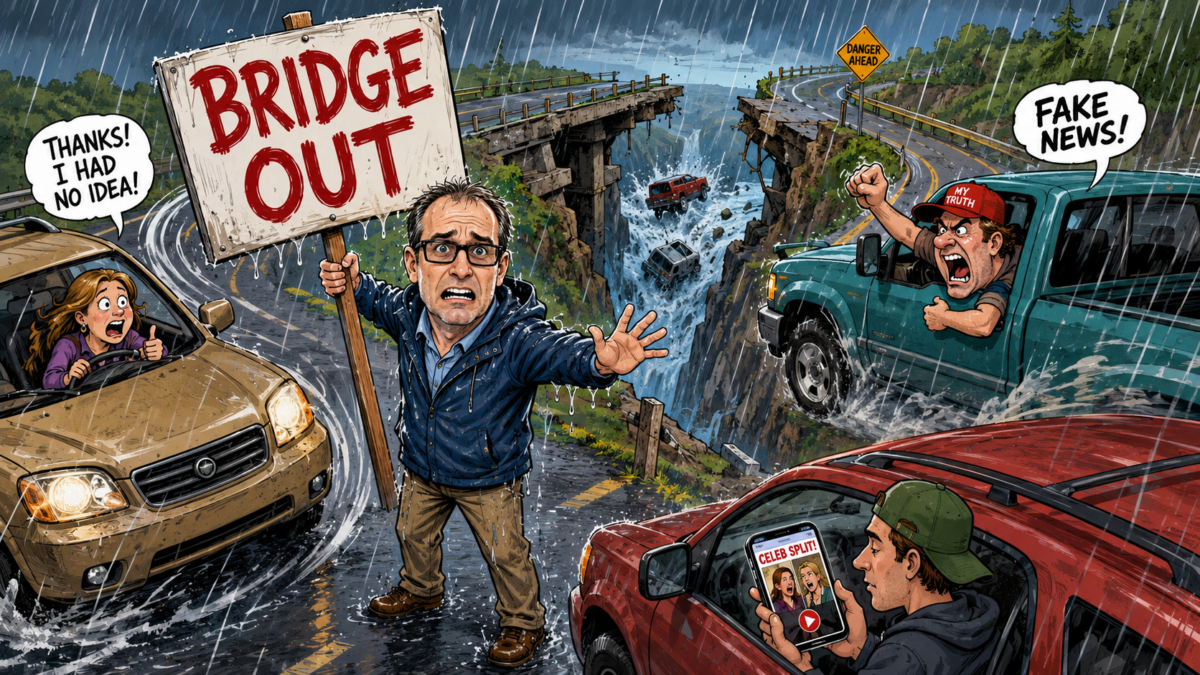
I have often said that being a journalist is a lot like being the person standing beside a bridge that is out, holding a giant sign that says BRIDGE OUT.
It is not a glamorous job.
You stand there in the rain, waving your arms, trying to get people’s attention while traffic comes barreling toward the missing bridge at 55 miles per hour. One person slows down, rolls down the window, and says, “Thank you. I had no idea.”
That person is why we do it.
Another person drives past without looking up because they are watching a video about a celebrity’s divorce on their phone.
A third person leans out the window and yells, “FAKE NEWS!” before accelerating directly toward the cliff.
Every now and then, somebody actively tries to hit you with their car.
And then, after several cars have sailed gracefully into the ravine below, somebody finally hits the brakes, steps out, looks at the bridge-less hole in the road, and says, with great outrage:
“Why didn’t anybody tell us?”
Friend.
I have been standing here with a sign.
The controversy over Flock cameras — those license-plate-reading cameras mounted around neighborhoods, shopping centers, roads, parking lots, and increasingly every other place a person might need to go buy dog food — is one of those bridge-out moments.
People are upset now. And honestly, they have every right to be upset.
Police officers in communities from Whynot to Knockemstiff have been caught using surveillance systems in ways that look a whole lot less like solving crimes and a whole lot more like a man with a badge having access to entirely too much information about another human being’s life.
People are asking whether these cameras can be misused. They are asking who can access the data. They are asking how long it is kept. They are asking whether police departments, private companies, neighborhood associations, and other government agencies have quietly assembled a map of where regular folks drive, shop, visit, worship, work, eat lunch, and take their dogs for a walk.
Those are good questions.
They are also questions journalists have been asking for years.
Before Flock cameras became the shiny new must-have accessory for police departments, local governments were debating license plate readers in police cars. The pitch was simple enough: A patrol car could drive through a parking lot or down a street, scan every visible license plate, and alert the officer if one belonged to a stolen vehicle or a person wanted for a serious crime.
That sounds useful. It can be useful.
If the police find a stolen car, locate a missing person, or identify a suspect in a violent crime because a license-plate reader caught the vehicle, that is a real benefit. Nobody serious is arguing that police should solve crimes with a flashlight, a notepad, and one of those magnifying glasses Sherlock Holmes carried around for dramatic effect.
But there was always another side to it.
The same tool that tells police a stolen vehicle passed through a parking lot can also tell them where a vehicle has been. And if enough cameras are collecting enough information, it can paint a fairly detailed picture of someone’s life.
Not a criminal’s life, necessarily.
Anybody’s life.
Your life.
It can show that your car was outside a medical clinic. A divorce lawyer’s office. A place of worship. A union hall. A political meeting. Your ex-boyfriend’s apartment. Your current boyfriend’s apartment. The Taco Bell you swore you were not going to visit again after what happened last time.
The technology does not know the difference between a dangerous criminal and a person who is having an extremely complicated Tuesday.
Journalists reported on that. We spoke with police officials, privacy advocates, technology companies, civil-liberties lawyers, residents, elected officials, and that one man at every public meeting who says “I’ve done my research” right before producing a stack of printouts held together by a rubber band.
We explained the benefit. We explained the risk.
We warned that an unscrupulous officer might use the systems to track an ex-partner, a neighbor, a family member, or somebody they had developed an unhealthy interest in. We warned that data collected for one purpose could find its way into the hands of people who had no business seeing it. We warned that every new piece of surveillance infrastructure is built by somebody promising they will use it responsibly, right up until somebody proves otherwise.
Then Flock cameras arrived.
Flock did not invent the idea of reading license plates. What it did was make the technology easier to install, easier to share, and easier to sell. Cameras went up in neighborhoods. Cameras went up at retail centers. Cameras went up on roads. Police departments bought them. Homeowners associations bought them. Businesses bought them.
Everybody wanted a little black box that could identify cars coming and going.
Again, the sales pitch was not entirely unreasonable. The cameras could help identify stolen vehicles. They could help investigate break-ins. They could potentially help locate suspects after a crime. A camera at the entrance to a neighborhood may be useful if somebody is burglarizing homes or stealing catalytic converters, which remains one of the more baffling criminal careers available to a person.
But the concern was always sitting right there in the fine print, blinking like a warning light on the dashboard.
These systems do not only track people who are suspected of crimes.
They track everybody who drives past.
The cameras may not know your name when they first read your plate. But plates can be connected to people. And when databases talk to one another — when local agencies share data, and regional agencies share data, and private systems and public systems begin building bridges between each other — the result can be a remarkably complete portfolio of your movements.
Some may call it public safety.
Others might call it a surveillance state.
Depending on who has the access, what rules are in place, how long the information is kept, and whether anybody is actually supervising the people using it, it can be both.
That was the warning.
It was not hidden in a cave. It was not delivered in coded messages. It was not carved into a stone tablet and buried under city hall by a secret society of journalists in fedoras.
It was in the local news.
Which brings us to “the media.”
Whenever somebody asks why “the media” did not report something, they usually mean CNN, Fox News, The New York Times, The Washington Post, and whichever national television network they believe is personally trying to ruin their breakfast.
Those organizations cover national news. They cover presidents, wars, elections, hurricanes, court cases, celebrities, and whatever strange thing Congress did before lunch.
They are not, generally speaking, going to cover your local town council approving a surveillance contract on a Wednesday night.
CNN is not dispatching Kaitlan Collins to cover the public-safety committee meeting where Councilman Bob asks whether the cameras come in black or beige.
Fox News is not sending a crew to the county commission meeting where a police chief gives a PowerPoint presentation titled “Innovative Technology Solutions for Community Safety.”
The national newspaper is not assigning its investigative desk to cover whether your homeowners association voted to put cameras beside the subdivision entrance, unless the HOA president is also laundering money for an international diamond cartel.
That is not because those local stories do not matter.
It is because that is the job of local journalism.
Local reporters attend the meetings. We read the agendas. We sit through the presentations. We ask what the technology does, who pays for it, who can access it, where the information goes, what safeguards exist, and what happens when somebody misuses it.
Then we write the story.
And I know what happens next, because I have watched it happen for most of my career.
The headline says something like, “City Council to Discuss License Plate Reader Contract,” and half the population immediately experiences a medical event known as Meeting Headline Narcolepsy.
Their eyes cross.
Their heads droop.
They wake up three hours later watching somebody argue online about a ballroom renovation, a vaccine, a celebrity trial, or whether Team Red has finally destroyed Team Blue forever this time.
Meanwhile, the city council voted.
The contract got signed.
The cameras went up.
And six months later, when the fourth cop in the community gets busted for stalking his ex-wife’s buff neighbor, the public awakens like a bear who has been poked with a stick.
“What is this?”
“Who approved it?”
“Why didn’t anyone tell us?”
We did.
You were taking the kids to ball practice or talking to the group chat about Prince Harry’s haircut.
It’s a lot harder to take the surveillance cameras down after the contract has been in place for several months than it is to be involved in your community and stop them from going up in the first place. Fox News and CNN aren’t going to tell you about your local city council. Heather Cox Richardson won’t be devoting 15 minutes to your board of education and Joe Rogan won’t be discussing your county commission votes on his show. If this is “the media” to you, they aren’t going to be warning your local government has gone and set fire to your privacy rights. Only your local news organizations will cover that, so you may want to consider paying attention to them
And since I’ve got your attention, let me tell you what the next Flock level conroversy is going to be, because I’ve seen this movie enough times in my career to know what comes next.
Police departments around the country are asking residents to register private cameras — doorbell cameras, driveway cameras, home security systems — with law enforcement.
The basic idea is that if a crime happens nearby, police can know which homes may have recorded useful video.
Again: There is a reasonable public-safety purpose here. If someone breaks into your neighbor’s house and your doorbell camera captured the vehicle, that footage might help solve the case.
Local news organizations have covered this when it happens in communities. It’s simple, you get an email or a notification from your local police department saying you can voluntarily register your cameras. I will remind you that the US tax system is voluntary too, but voluntary often has a different meaning to the government than it does to your church missions department. Anyway, your local news also questions what that registration means.
Does registering your camera give police automatic access to your video? Does it merely let them ask you for footage? Can they obtain footage without your consent? Can they access live feeds? What records are kept? Who can search them? What happens if an officer uses the system for personal reasons? What happens if the data is breached, sold, shared, subpoenaed, or otherwise ends up somewhere it should not be?
Those are not paranoid questions.
Those are the questions responsible adults ask before handing the government a map to every camera pointed at their front yard.
You can support police. I do.
You can believe that law enforcement needs modern tools to investigate serious crimes. I do.
You can back the blue and still understand that history contains a long, regrettable list of people who were given power, trusted with information, handed rules, and then decided the rules applied to everybody except them.
A uniform does not turn a person into an angel.
A badge does not cancel the Constitution.
And the Constitution, inconveniently for anyone who would like unrestricted access to your life, outranks the police department.
Privacy rights are not an insult to good officers. They are a protection for everybody — including good officers, who should not have to work under the cloud created by the bad ones who use government systems to settle personal scores, stalk women, intimidate critics, or satisfy a curiosity that ought to have stayed inside their own head.
The next chapter is already being written. Police want more access to cameras. Technology companies want more contracts. Governments want more tools. Residents want safety, which is a perfectly reasonable thing to want.
But safety and privacy are not enemies. They are both things a free society is supposed to protect.
So, read the local news.
Read the story with “meeting” in the headline, even if it makes your eyelids feel heavy. Show up before the vote. Ask the annoying questions. Ask them twice if the first answer sounds like it was assembled by a public-relations consultant in a windowless room.
And if you see a journalist beside a bridge holding a sign that says BRIDGE OUT, maybe slow down.
We are not there because we enjoy the view.


B.T. Clark is the Publisher of The Georgia Sun and author of Principles Are Like Pants… You Ought to Have Some. Over two decades in journalism, he has served as Managing Editor of Neighbor Newspapers in metro Atlanta and Digital Director at Times-Journal Inc., earning multiple awards along the way. His work has appeared in newspapers across the state, including The Cherokee Tribune and The Marietta Daily Journal.
- B.T. Clark
- B.T. Clark
- B.T. Clark

- B.T. Clark