

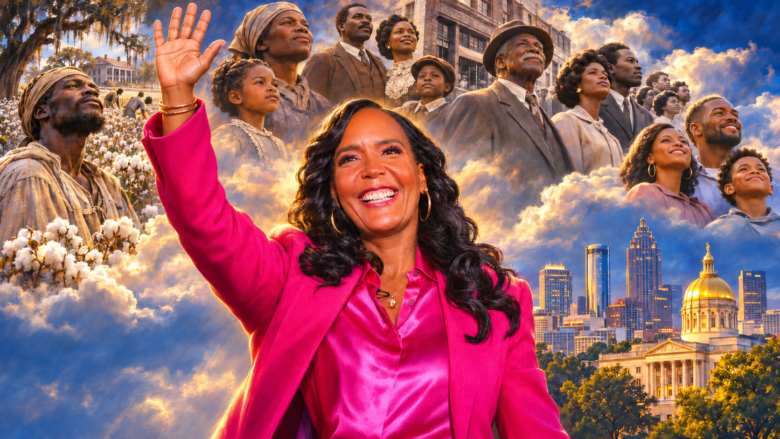
Sheppard Peek was a slave at a plantation in Crawfordville, Georgia. He was listed as the property of William Peek and was valued at $1,400. That was the price of a man 166 years ago. He wasn’t viewed as a man. He was only counted as three-fifths of a man, and he wasn’t allowed to own property, enter through the main door of a house, or vote.
Sheppard Peek, who was valued at just $1,400, would be absolutely shocked if he knew that his great-great-granddaughter was just elected Governor of the state that once put a price tag on him and allowed him to be bought, sold, and enslaved.
On November 3, Keisha Lance Bottoms was elected the 84th Governor of Georgia.
She is the first woman ever elected governor of Georgia. She is the first Black person of any gender ever elected governor of Georgia. And she is the first Black woman ever elected governor of any state in the entire United States of America. Not in the Northeast. Not on the West Coast. Not anywhere. The first one, in the whole country, came from Georgia. The state that once appraised her great-great-grandfather like a piece of farm equipment.
History has a sense of humor. It is not always a kind one, but it is always working.
To understand what happened Tuesday, you have to understand what $1,400 meant. At the time Sheppard Peek was listed among the possessions of William Peek in Crawfordville, $1,400 represented nearly four years of wages for an average working man. It was roughly equivalent to the value of more than 230 acres of Georgia farmland, buildings included. That was what the state decided a human being was worth. On at least one surviving document, Sheppard Peek signed his name with an X, because the state that valued him at $1,400 had not seen fit to teach him to write.
His great-great-granddaughter just won 55% of the vote.
Bottoms herself acknowledged the weight of where she comes from. In her victory speech, she said, “I am at least a fifth-generation Georgian. I say ‘at least’ because we can only trace our family back five generations — to a plantation in Crawfordville.” She said it plainly, without theater, the way Georgians tend to say hard things — because down here, the hard things are just the facts, and the facts are just the ground you’re standing on.
She was born in Atlanta. Her father is R&B singer Major Lance, which means she came into this world with music in the house and Georgia clay under her feet. She went to Frederick Douglass High School, earned her law degree from Georgia State University, and then proceeded to work her way through all three branches of government — judge, city council member, and mayor.
Her grandfather left rural Georgia and came to Atlanta during the era of Jim Crow. When he walked through downtown Atlanta, he used the back doors — the ones designated for Black residents, because that was the law and that was the custom and that was Georgia being its worst self. Decades later, his granddaughter walked through the front doors of those same buildings as the 60th mayor of Atlanta.
And now she is the governor.
Five generations from the fields of a plantation to the governor’s mansion. That’s her story. And in many ways it is the story of Georgia and the story of the South.
Now, if you voted for her opponent, you are allowed to be disappointed. That is what elections are. Somebody wins and somebody doesn’t, and the somebody who doesn’t gets to be unhappy about it for a reasonable period of time before life moves on.
But here is what belongs to everyone, regardless of how you voted: Georgia made history on election night. This state — this specific, complicated, contradictory, beautiful, maddening state — did something no other state in the union had ever done. And it did it first. Not Massachusetts. Not California. Not Illinois. Georgia.
The same Georgia that wrote Sheppard Peek’s name in a ledger next to a dollar amount. The same Georgia where a man signed his name with an X because no one had bothered to teach him otherwise. The same Georgia where a grandfather used the back door because the front door wasn’t for him.
That Georgia just elected Keisha Lance Bottoms governor.
She pledged in her victory speech to be a governor for all Georgians — for the ones who voted for her and the ones who didn’t. Whether you believe her is up to you. Whether you agree with her policies is up to you. Whether you think she’ll do a good job is a question only the next four years can answer.
But whether she is a part of Georgia’s history is not up for debate. That part is already done. Her story is Georgia’s story. Keisha Lance Bottoms’ family went from slavery to governing. In many ways, Georgia has ridden the same wave. It went from a debtor’s colony, to a slave state, to a major player on the national political and business scene. The state and its next governor look a lot like each other.



B.T. Clark is the Publisher of The Georgia Sun and author of Principles Are Like Pants… You Ought to Have Some. Over two decades in journalism, he has served as Managing Editor of Neighbor Newspapers in metro Atlanta and Digital Director at Times-Journal Inc., earning multiple awards along the way. His work has appeared in newspapers across the state, including The Cherokee Tribune and The Marietta Daily Journal.
- B.T. Clark

- B.T. Clark

- B.T. Clark

- B.T. Clark
